When it comes down to it, it's not that hard to find additional lists that places West Virginia last. And the CDC has generated yet another. It turns out that West Virginians are the most sleepless of all the 50 states, with 1 in 5 residents reporting that they didn't get a single good night's sleep within the last month.
(I'm having trouble finding the actual study itself-- help?)
The determinants of sleeplessness at the state level, anyone? Average number of kids? Long-term career opportunities?
Friday, October 30, 2009
Thursday, October 29, 2009
2009 Gus Rankings: Week 8
It's a bit tardy, but here's this week's Gus Rankings. Iowa still holds the top spot, and Temple finds itself at 23-- a tribute to it's 5-1 record in FBS games, but also a highlight of the difficulty in accounting for FCS losses. The Owls lost to Villanova to start the season. We'll have to find a way to deal with this situation next year, but a non-arbitrary solution has thus far avoided me. I'm open to suggestions...
File this under: Quote of the day, ideas, bad
In the process of perusing as much literature as possible on global public goods, I came across this gem:
Honestly-- that's exactly how it reads. As a section header, no less.
Just to clarify-- the policy suggestion is to generate seigniorage for the goal of promoting financial stability.
Wow.
It's from Global Public Goods: Taking the Concept Forward. And who, you ask, published this nugget of wisdom? The United Nations Development Programme, that's who. Let's hear it-- the international development community, everyone!
Capacity building in developing countries is critical to achieving the objective of financial stability and market efficiency. The seigniorage earned by the central banks of industrial countries could be an appropriate funding source.
Honestly-- that's exactly how it reads. As a section header, no less.
Just to clarify-- the policy suggestion is to generate seigniorage for the goal of promoting financial stability.
Wow.
It's from Global Public Goods: Taking the Concept Forward. And who, you ask, published this nugget of wisdom? The United Nations Development Programme, that's who. Let's hear it-- the international development community, everyone!
More Peltzman Effects in NASCAR
From Public Choice, "Rubbin' is Racin'" by Pope and Tollison:
The Peltzman Effect is a well known and controversial theory in the literature. Studies have struggled to find a dataset that can accurately test for the presence of the effect. We have created a unique dataset and use a natural experiment from the sport of stock car racing to test the theory. Using race-level data from NASCAR events, we find strong evidence that a major safety regulation has led to more on-track accidents and an increased risk to both spectators and pit crew members.FYI: If you were wondering how this differed from a 2007 paper by Nesbit and Sobel, according to footnote 5, page 5, the Pope and Tollison dataset covers the implementation of the HANS device.
Wednesday, October 28, 2009

On Distance Variables in Hedonic Regressions
My paper "Inconsistency in Welfare Inferences from Distance Variables in Hedonic Regressions" with Michael Farmer and Cliff Libscomb is now forthcoming in the Journal of Real Estate and Finance Economics. It's intended audience is for researchers doing applied work that involve estimating the determinants of housing prices.
If you are considering using a "distance to" variable in a housing demand regression, below the fold you can find the cliff notes from the paper on why direct interpretation of these variables is misleading.
+/-
If you are considering using a "distance to" variable in a housing demand regression, below the fold you can find the cliff notes from the paper on why direct interpretation of these variables is misleading.
+/-
Tuesday, October 27, 2009
Brad Delong and Scott Sumner, "Fed Up"
In a Reason magazine article entitled Fed Up, Brian Doherty writes:
The Berkeley economist Brad DeLong, a popular blogger and former Clinton Treasury Department official who once dismissed Mises’ general monetary theory as “batshit insane,” still told this story in the October 2008 issue of the liberal American Prospect: “The current financial crisis has its roots in Greenspan’s decision to keep interest rates very low in 2002 and 2003 to head off the danger of a deflation-induced double-dip recession.…Six months ago, I would have said that his judgment was probably correct. Today… I can no longer state that Greenspan made the right calls with respect to the level of interest rates and the housing bubble in the 2000s.”Interesting. What do you think?
[...]
Scott Sumner, a monetary economist at Bentley University who writes the much-cited blog The Money Illusion, thinks the Federal Reserve was and is too tight with interest rates and money for optimal economic performance. “As everyone knows by now,” Sumner complained in June, “the once kooky and discredited Austrian business cycle model has now become conventional wisdom.”
Congrats to David on the 2009 Lavoie Prize!
It has been announced that TPSer David Skarbek has won one of this year's three Lavoie Prize for his paper on "Self-Governance in San Pedro Prison."
Here is a blog post where David summarizes this work, in which he explains why the San Pedro prison is among the safest prisons despite being governed by prisoners instead of guards.
Congrats, David!
Here is a blog post where David summarizes this work, in which he explains why the San Pedro prison is among the safest prisons despite being governed by prisoners instead of guards.
Congrats, David!
Monday, October 26, 2009
Vromen on Freakonomics
TC at MR points us to Jack J. Vromen's essay in the Erasmus Journal for Philosophy and Economics, titled "The Booming Economics-Made-Fun Book Genre: More Than Having Fun, But Less Than Economic Imperialism."
It was the second part of the title that caught my interest, and indeed the essay is not so much a recent review of the way in which economics has expanded in popularity as it is a discussion of what constitutes economics and its place in social science. In particular, Vromen offers a response to the genre's critics that view this as "economics imperialism."
These critics are found in the other social sciences and parley their overall critique of economics (or at least what they perceive economics to be) and its expansion into "their" subject matter. By "their" subject matter, it is taken to mean the general non-econ aspects of life that tend to be discussed in this genre (more sex is safer sex, tipping your dentist, identifying the cheating sumo wrestlers, etc). They apparently view this as economists stealing their subject matter to apply our own (distasteful) methodology towards understanding it. In short, the criticism is that they do not want people "thinking like economists" in their subject area.
My favorite passage comes on page 79, in which he dismisses this critisim on the grounds that ideas are public, not private goods (whether he catches the irony or not, I cannot tell):
It was the second part of the title that caught my interest, and indeed the essay is not so much a recent review of the way in which economics has expanded in popularity as it is a discussion of what constitutes economics and its place in social science. In particular, Vromen offers a response to the genre's critics that view this as "economics imperialism."
These critics are found in the other social sciences and parley their overall critique of economics (or at least what they perceive economics to be) and its expansion into "their" subject matter. By "their" subject matter, it is taken to mean the general non-econ aspects of life that tend to be discussed in this genre (more sex is safer sex, tipping your dentist, identifying the cheating sumo wrestlers, etc). They apparently view this as economists stealing their subject matter to apply our own (distasteful) methodology towards understanding it. In short, the criticism is that they do not want people "thinking like economists" in their subject area.
My favorite passage comes on page 79, in which he dismisses this critisim on the grounds that ideas are public, not private goods (whether he catches the irony or not, I cannot tell):
This presupposes that subjects (and issues and phenomena in general) can be appropriated by some discipline in a similar way as natural resources in some territory, such as oil and gas, can be appropriated by some foreign country or company. But are the subjects tackled or addressed by some discipline like that? If economists start tackling “outlandish” phenomena, are other disciplines that traditionally tackled these phenomena thereby denied access to them? It seems not. Unlike natural resources, which are private goods, subjects are more like public goods. Their “use” by the one discipline does not diminish the opportunities for other disciplines to “use” them. Disciplines cannot be dispossessed of their subjects in the same way that countries can be dispossessed of their natural resources.That is thinking like an economist to determine the subject domain of economics, and the critics will not like it. I loved the essay, and highly recommend it.
Friday, October 23, 2009
Happy Anniversary to the Berlin Wall Collapse
Do check out this book review on the subject at Reason:
On February 6, 1989, Gueffroy and a friend attempted to escape from East Berlin by scaling die Mauer—the wall that separated communist east from capitalist west. They didn’t make it far. After tripping an alarm, Gueffroy was shot 10 times by border guards and died instantly. His accomplice was shot in the foot but survived, only to be put on trial and sentenced to three years in prison for “attempted illegal border-crossing in the first degree.”
Twenty years ago this month, and nine months after the murder of Gueffroy, the Berlin Wall, that monument to the barbarism of the Soviet experiment, was finally breached.
[...]
When the whole rotten experiment suddenly failed, eventually bringing to an end not just Moscow’s Warsaw Pact client governments but the proxy civil wars it fought in the Third World, instead of engaging in overdue self-criticism many commentators clung to shopworn shibboleths. In 1990 the academic Peter Marcuse, also writing in The Nation, bizarrely claimed that East Germany “had never sent dissidents to gulags and rarely to jail” and expressed outrage that the “goal of the German authorities is the simple integration of East into West without reflection,” instead of heeding the pleas of the intellectual class who were at work on a more humane, less Russian brand of socialism.
Thursday, October 22, 2009
Blockquoting X
X = Mancur Olson, The Rise and Decline of Nations:
Special-interest groups also slow growth by reducing the rate at which resources are reallocated from one activity or industry to another in response to new technologies or conditions. One obvious way in which they do so is by lobbying for bail-outs of failing firms, thereby delaying or preventing the shift of resources to areas where they would have a greater productivity (1982, 63-64).
File this Under... Profit and LOSS System
They are called Winkers. Just watch the video.
[HT: Angela]
[UPDATE!]
Here are some additional details from the Winkers Website:
[HT: Angela]
[UPDATE!]
Here are some additional details from the Winkers Website:
Year Introduced: 2009I stand by my original prediction that the market will sort this entrepreneur accordingly (and by that, I mean into the waste bin). Please let me know if you spot a pair of Winkers in your neighborhood, though. In fact, take a picture and I'll post it on the blog.
Developer: William A. Jones, a retired man from Washington state
Price range: $149-569
Each pair hand-painted by request
Available in human eyes, ducks, clap boards, owl eyes and lion eyes
Nook-and-Mortar
I am tentatively planning on buying a e-reader in the Spring, so I've been keeping an eye on the new product lines that are coming out, the latest being the Nook from Barnes and Noble. It is hard not to appreciate the way innovation has been the primary point of competition. My favorite examples from a Wired review:
There is also a relevant status signaling issue. When e-Reader's first started coming to the market, some critics remarked that it would not take hold because it would hide people's "intellectual trophy case i.e. the giant bookshelf of all the books I've read." I suppose now e-Readers create a mobile trophy case of unrevealed size, increasing the status of those who read at least enough to warrant the purchase of an e-Reader.
One of the best things about hardcovers or paperbacks is that you can give them to family and friends. E-readers, so far, haven’t offered that to consumers. Instead, devices such as Kindle have locked down books and made it impossible for users to lend books that they have bought. Nook tries to change that with its LendMe feature. Nook users can loan books to friends for two weeks and those e-books can be accessed through PCs or smartphones such as the BlackBerry and the iPhone. Lending the book through Nook makes it unavailable to the original owner, but at the end of the two weeks, the book reverts back to its owner.Will future Barnes and Noble stores be replaced by coffee shops with wireless access to their books? How will libraries adapt to a world in which returns will be automatic, and hence no late fees?
[...]
Most of us turn to Amazon when it comes to buying books, but there is something to be said for walking into a bookstore, sitting there with a cup of coffee and browsing. The Nook lets you do just that. In a neat trick that takes advantage of Barnes & Noble’s brick-and-mortar stores, the Nook lets users read entire e-books for free in-store.
There is also a relevant status signaling issue. When e-Reader's first started coming to the market, some critics remarked that it would not take hold because it would hide people's "intellectual trophy case i.e. the giant bookshelf of all the books I've read." I suppose now e-Readers create a mobile trophy case of unrevealed size, increasing the status of those who read at least enough to warrant the purchase of an e-Reader.
Wednesday, October 21, 2009
F. Scott Fitzgerald's tax returns
Think that reading about tax returns is interesting? Me neither, but I thought this was an interesting bit about F. Scott Fitzgerald and his tax returns. Some fun bits:
And for my first effort with the hide-a-text function, do you know which book of his was most printed during his lifetime?
+/-
That year [1920] only roughly 7 percent of the population—7,259,944—even filed tax returns. Today, about 45 percent of the population files returns...
...
...the modern equivalent of Fitzgerald’s annual income would be roughly $500,000...Fitzgerald’s income was almost tax free (5.5 percent effective rate), while today’s taxpayer making $500,000 would probably pay 40 percent in income and Social Security taxes.
...
Over Fitzgerald’s working life, he reported a total of $449,713 in gross income, and he paid $24,666 in taxes—thus the effective tax rate of 5.5 percent.
And for my first effort with the hide-a-text function, do you know which book of his was most printed during his lifetime?
+/-
Externalities: Body Odor Edition
From the AP (dated 9/2/2009):
Update: Rachel Herz points out a similar ban has been in place in Novia Scotia for a few years:
HONOLULU - A vote on a Honolulu City Council proposal that would bar people with offensive odors from public transit vehicles is being delayed.
The proposed ordinance would make it illegal to have "odors that unreasonably disturb others or interfere with their use of the transit system."
Councilman Nestor Garcia said Wednesday the proposal has some technical problems that need to be addressed.
Granted, Coasian bargaining probably doesn't work here. I assume they mean city-owned when they say "public transit," so there is a legitimate concern of granting the property right to the party that values it the most. In this case, some people value being stinky while others value the absence of stink on people.
Update: Rachel Herz points out a similar ban has been in place in Novia Scotia for a few years:
The city of Halifax in Nova Scotia imposed a ban on scent in 2000, specifically artificial scent, which resulted in elderly ladies being kicked off buses for wearing perfume and high school students being accused of "assault" for sporting hair gel and Aqua Velva in class. I have not found confirmation that anyone has ever been jailed or fined for these Canadian scent offenses.Herz goes on to point out, legitimately in my view, that the psychology of smell coupled with these laws could create class and race issues.
Tuesday, October 20, 2009
2009 Gus Rankings: Week 7
Here are this week's Gus Rankings. Of note:
- Note that Virginia Tech, with two losses, is still ranked very high (#4). Recall that their losses are to teams that are a combined 12-1. Losing to good teams does little harm in the Gus Rankings.
- There are seven undefeated teams left, and the lowest is ranked #11.
- As the season presses on, there is more spread in the rankings-- 39 points between the highest and lowest-- but also more opportunity for larger movements for individual teams due to the fact that your score is a function of the performance of more and more teams (namely, the ones you've already played).
The BCS rankings just came out for the first time this week; don't worry, we're watching how Gus stacks up to it and others as the season progresses...
- Note that Virginia Tech, with two losses, is still ranked very high (#4). Recall that their losses are to teams that are a combined 12-1. Losing to good teams does little harm in the Gus Rankings.
- There are seven undefeated teams left, and the lowest is ranked #11.
- As the season presses on, there is more spread in the rankings-- 39 points between the highest and lowest-- but also more opportunity for larger movements for individual teams due to the fact that your score is a function of the performance of more and more teams (namely, the ones you've already played).
The BCS rankings just came out for the first time this week; don't worry, we're watching how Gus stacks up to it and others as the season progresses...
Monday, October 19, 2009
More state business rankings!
It's almost to the point where there's no end to the ways to describe a similar idea. Economic freedom/state business climate/best place to start a business, anyone?
Anyhow, here's a list from Forbes that talks about the best places to launch a small business. The ranking seems to be an indication of the number of small businesses per capita...if that's the case, it misses some of the details, but as a general overview it's still worthwhile.
One of these days with these rankings...
Anyhow, here's a list from Forbes that talks about the best places to launch a small business. The ranking seems to be an indication of the number of small businesses per capita...if that's the case, it misses some of the details, but as a general overview it's still worthwhile.
One of these days with these rankings...
How much stimulus money actually gets spent?
Seems like a fair question; Andrew Leigh takes a stab at it, at least in Australia, emphasis is mine:
Regardless of what side of the fence you're on, it's important to note the non-equivalence on the consumption end between tax rebates and stimulus checks. (Albeit between different nations.)
Using survey evidence, I estimate the impact of a $12 billion package of household payments delivered in Australia between March and May 2009. Forty percent of households who said that they received the payment reported having spent it. This is approximately twice the spending rate that has been recorded in surveys assessing the 2001 and 2008 tax rebates in the United States. Using an approach for converting spending rates into an aggregate marginal propensity to consume (MPC), this is consistent with an aggregate MPC of 0.41-0.42. Since this estimate is based only on first-quarter spending, it may be an underestimate of the longer-run impact of the package on consumer expenditure.
Regardless of what side of the fence you're on, it's important to note the non-equivalence on the consumption end between tax rebates and stimulus checks. (Albeit between different nations.)
Understanding the Equal Marginal Benefit Principle
Note: This post is going into my teaching archive to help students who miss this particular class. For my fellow econ teachers, you might find it an alternate way of teaching EMBP.
The equal marginal benefit principle says that consumers will chose their consumption bundle in such a way that the Marginal Utility (MU) per dollar will be equal across all goods. In other words, the last commodity they purchase will yield the same level of marginal utility per dollar spent. Mathematically, it is expressed across N goods as:
 It is important to understand that this condition is referring to an outcome of a process, that is, it is something consumers are moving towards. The intuition can be illustrated with a simple example.
Suppose a consumer is at a football game with $10 of income he plans to spend. With this $10, he can purchase different quantities of pretzels, beers, and nachos, which are each $1 in price. The Table below illustrates the marginal utility experienced with each unit of consumption:
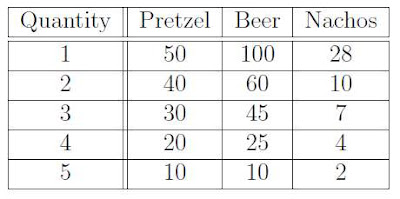
Notice that with each item, they experience diminishing marginal utility (the more they have, the less they want a little bit more).
Based on the above table, how will the consumer spend the first of their $10? It makes sense that they would get "the most bang for their buck" and buy the first beer, which yields 100 marginal utils (as opposed to 50 or 28 for pretzels and nachos, respectively).
 Now, how does the consumer spend their 2nd dollar? They could buy their first pretzel (50 more utils), their second beer (60 more utils), or their first nacho (28 utils). Since the second beer adds to their utility at the greatest rate, they will have the second beer.
 How about the third dollar? They can buy their first pretzel (50 more utils), their third beer (45 more utils), or their first nacho (28 more utils). With their third dollar, they will purchase their first pretzel. This process continues, of course, so that we can see a break down of how each dollar of spending will occur:

 As you can see, with the first $9 they purchased 4 pretzels, 4 beers, and 1 nacho, and are now indifferent on the 10th dollar of spending. On the 10th dollar, the marginal utility is equal across all goods.
See Also: The EMBP in One Picture
The equal marginal benefit principle says that consumers will chose their consumption bundle in such a way that the Marginal Utility (MU) per dollar will be equal across all goods. In other words, the last commodity they purchase will yield the same level of marginal utility per dollar spent. Mathematically, it is expressed across N goods as:
 It is important to understand that this condition is referring to an outcome of a process, that is, it is something consumers are moving towards. The intuition can be illustrated with a simple example.
Suppose a consumer is at a football game with $10 of income he plans to spend. With this $10, he can purchase different quantities of pretzels, beers, and nachos, which are each $1 in price. The Table below illustrates the marginal utility experienced with each unit of consumption:
Marginal Utility per Unit by Item

Notice that with each item, they experience diminishing marginal utility (the more they have, the less they want a little bit more).
Based on the above table, how will the consumer spend the first of their $10? It makes sense that they would get "the most bang for their buck" and buy the first beer, which yields 100 marginal utils (as opposed to 50 or 28 for pretzels and nachos, respectively).
 Now, how does the consumer spend their 2nd dollar? They could buy their first pretzel (50 more utils), their second beer (60 more utils), or their first nacho (28 utils). Since the second beer adds to their utility at the greatest rate, they will have the second beer.
 How about the third dollar? They can buy their first pretzel (50 more utils), their third beer (45 more utils), or their first nacho (28 more utils). With their third dollar, they will purchase their first pretzel. This process continues, of course, so that we can see a break down of how each dollar of spending will occur:
 As you can see, with the first $9 they purchased 4 pretzels, 4 beers, and 1 nacho, and are now indifferent on the 10th dollar of spending. On the 10th dollar, the marginal utility is equal across all goods.
See Also: The EMBP in One Picture

Subscribe to:
Posts (Atom)