I have not seen op-eds saying that the real-world bill is better than no bill. Even Professor DeLong’s article doesn’t come out and say that. He and many other economists did sign a January 27, 2009 letter favoring the bill. Are there other writings in favor of the bill by research economists that I have missed?
Tuesday, March 31, 2009
Where are the People with the Data?
Eric Rasmusen, one of my colleagues here at IU, asks:

The Microsoft Bridge
Here is a CNN piece on Microsoft receiving stimulus money to complete their campus-connecting bridge. In short, Microsoft planned to fund this bridge themselves but costs increased beyond their initial $25M level, and so the company applied for stimulus funds to cover the $11M shortfall. In all, Microsoft is contributing $17.5M to the $36M project, or just less than half.
First and foremost, the quote concerning foregone opportunities due to the spending is refreshingly spot-on.
But as is often the case with government spending, we're left choosing between worst and not as bad. Given that we've got this albatross of stimulus money, is it going to places where it will, in the long run, do the least harm? There are things to like about this project in light of others. As opposed to a bridge built to nowhere, Microsoft did value this bridge at a minimum of $17.5M, and put its money behind it in the first place-- rising costs tipped it beyond its value to the firm, however. Instead of funding projects in which we must blindly guess the value to society, is it that horrible by comparison to help finish this project? In the global sense, is it an efficient use of funds? No-- but again, we're not going to have efficient spending when it comes to public spending, so what we need to task is to find the least harmful outputs.
Of course, making a broad-based policy of requiring a private matching sum would end up in a lot of projects that simply aren't efficient. So this isn't good policy that could be instituted on a wide scale.
There's a lot of angles to take on this one.
First and foremost, the quote concerning foregone opportunities due to the spending is refreshingly spot-on.
But as is often the case with government spending, we're left choosing between worst and not as bad. Given that we've got this albatross of stimulus money, is it going to places where it will, in the long run, do the least harm? There are things to like about this project in light of others. As opposed to a bridge built to nowhere, Microsoft did value this bridge at a minimum of $17.5M, and put its money behind it in the first place-- rising costs tipped it beyond its value to the firm, however. Instead of funding projects in which we must blindly guess the value to society, is it that horrible by comparison to help finish this project? In the global sense, is it an efficient use of funds? No-- but again, we're not going to have efficient spending when it comes to public spending, so what we need to task is to find the least harmful outputs.
Of course, making a broad-based policy of requiring a private matching sum would end up in a lot of projects that simply aren't efficient. So this isn't good policy that could be instituted on a wide scale.
There's a lot of angles to take on this one.
Monday, March 30, 2009
Assorted links, March 30
TPS Middle East traveler Thomas Johnson sends along this beer map of America. Note the back-of-the-envelope calculations put West Virginia as the worst beer state. Maybe Yuengling deciding to sell beer here will help ease the pain.
And here is a ranking for the best places for business and careers. I'm going to aggregate these rankings here in the near future and make sense of it all...
And here is a ranking for the best places for business and careers. I'm going to aggregate these rankings here in the near future and make sense of it all...
Brilliance
From CNN:
President Obama announced Monday that struggling automotive giants General Motors and Chrysler will be given a "limited" period of time to "restructure in a way that would justify an investment of additional taxpayer dollars."What a phenomenal idea! In fact, if GM and Chrysler restructure in a way that justifies additional investment, taxpayers will give them money directly instead of via government bureaucrats!
The Economist Says...These Two Statements are the Same
In canceling my subscription to Weight Watchers, the online form asked me to check the box that describes the reason. Notice that, in economics, these two statements mean the same thing:


Saturday, March 28, 2009
Hayek Online
 Via Peter Klein at Organizations and Markets, Hayek's excellent Individualism and Economic Order is now online (in addition to works by Menger and White).
Crowd Tournament Picks
Yahoo provides the data for the distribution of picks in each round of the NCAA Tourney. It also provides the crowd's bracket, based on the distribution of these picks. If the crowd was in the group I am playing in, it would be the clear leader.
Nevertheless, looking over it, I'm not sure this is the crowd's bracket. I think it would need to be worked out with Bayes Theorem to be reflective of the group's choice. It would be a fun project to go ahead and work this out, hopefully there are some takers.
Nevertheless, looking over it, I'm not sure this is the crowd's bracket. I think it would need to be worked out with Bayes Theorem to be reflective of the group's choice. It would be a fun project to go ahead and work this out, hopefully there are some takers.
Friday, March 27, 2009
How Studying in the Social Sciences Can Ruin Your Brain
I was at the public library the other day for a puppet show with the family. One of the Dads was clapping obnoxiously throughout the show. I then noticed his wife had only one arm. I began to wonder if he was not being obnoxious, but just overcompensating for the fact his wife could not clap at all. For a brief second I started to think about where I could get data.
Perhaps next Spring Break I should actually take some vacation time.
Perhaps next Spring Break I should actually take some vacation time.
Thursday, March 26, 2009
Name that process!
Justin's previous post about the Senate's investigation of the BCS touches on an issue that gets brought up here with increasing frequency-- that of Congress getting involved in a range of issues, which, in turn, crowds out their ability to influence the economy. And this is a good thing.
Well, I think we should name it.
So put properly: What would you name the situation of Congress focusing on trivial issues, thereby preventing them from harming the American economy?
I'm going to offer the Unintentionally Beneficial Congressional Sidestep, but I'm open to suggestions. Wordy, yes, but UBCS is quick to write. Maybe a better acronym could be had.
Well, I think we should name it.
So put properly: What would you name the situation of Congress focusing on trivial issues, thereby preventing them from harming the American economy?
I'm going to offer the Unintentionally Beneficial Congressional Sidestep, but I'm open to suggestions. Wordy, yes, but UBCS is quick to write. Maybe a better acronym could be had.
From the Department of Thank Goodness
Sarcasm Off: This is the most socially beneficial use of the Senate's time these days. From the AP:
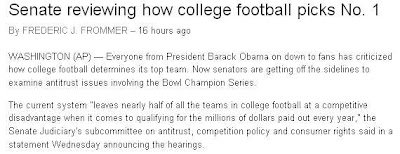 Sarcasm On: Congratulations to the Senators for realizing the real anticompetitive problem with NCAA sports!
Hat Tip: Jason Oberle
 Sarcasm On: Congratulations to the Senators for realizing the real anticompetitive problem with NCAA sports!
Hat Tip: Jason Oberle
Negative Externalities Example
For the classroom, a negative consumption externality:
Hat Tip: Kyle Conover
Hat Tip: Kyle Conover
Wednesday, March 25, 2009
What Will It Take To Get You To Stop Trying?
I find this idea bizarre (Hat Tip: Jason Oberle):
Exactly what was stopping them from being non-profit before? The internet has already provided a vast array of non-profit media outlets. I'm not sure what to make of this news.WASHINGTON (Reuters) - With many U.S. newspapers struggling to survive, a Democratic senator on Tuesday introduced a bill to help them by allowing newspaper companies to restructure as nonprofits with a variety of tax breaks.
"This may not be the optimal choice for some major newspapers or corporate media chains but it should be an option for many newspapers that are struggling to stay afloat," said Senator Benjamin Cardin.
Tuesday, March 24, 2009
Too Voter Visible to Fail
at TAE has a great post on the "Too Big To Fail Fallacy." Throughout it he points out the difficulty of line drawing of what constitutes "too big." The Madoff investors? Workers on Main Street? Do read the whole thing.
My thinking on the subject is that it is not a linear relationship, where small groups add up into big collectives, but a circular one. "We" want to protect the local Mom-n-Pop's because of how cute and localish they are, and thus "we" don't want to see them fail. They're just so tiny and cute, how can you just let them fail?
The further you move in either extreme of size, the more likely you are to have populist and elitist support for circumventing their evolution.
My thinking on the subject is that it is not a linear relationship, where small groups add up into big collectives, but a circular one. "We" want to protect the local Mom-n-Pop's because of how cute and localish they are, and thus "we" don't want to see them fail. They're just so tiny and cute, how can you just let them fail?
The further you move in either extreme of size, the more likely you are to have populist and elitist support for circumventing their evolution.
A Quick Rejoinder
Daniel Gross of Slate asks:
Man Up, Capitalists!A: Because the last government "bribe for risk" exchange left them bankrupt.
Why does the treasury secretary have to bribe investors to take risks?
Kindling
TC points us to this story on gender differences in reading:
Men are also more likely to have shelves full of books that have never been opened.Ah ha, so men use their book shelves for signaling purposes. My first thought then was that men would be slower to adopt the Kindle than women. My second thought was that men would be faster to adopt the Kindle than women because now they can carry their signal around with them.
Easterly tonight at WVU
William Easterly, author of The Elusive Quest for Growth and White Man's Burden, as well as a slew of academic articles, will be speaking tonight here at WVU. If you're in the area, I highly recommend attending, if for no other reason than the chance for a few choice off-handed Sachs comments. 7:30pm, Brooks Hall, Room 202.
As an aside, it turns out that Easterly was actually born in Morgantown.
As an aside, it turns out that Easterly was actually born in Morgantown.
Free Trade Blurb
Having signed the free-trade petition currently circulating, I answered an email asking for a quotation. Here was what I provided:
Protectionism has been intellectually bankrupt for more than 230 years, so ignorance is no excuse. No public servant can honestly promote peace and prosperity without a policy of international free trade, and anyone who tries is guilty of self-interested populism.
Monday, March 23, 2009
Statistics I don't believe
From the Becker-Posner blog:
Addendum: Here is more information the study.
"The Harris study also estimated that over two percent of all persons marrying between April 2006 and March 2007 were introduced through eHarmony."
Addendum: Here is more information the study.
Subscribe to:
Posts (Atom)