Wednesday, October 21, 2009

F. Scott Fitzgerald's tax returns

Think that reading about tax returns is interesting? Me neither, but I thought this was an interesting bit about F. Scott Fitzgerald and his tax returns. Some fun bits:

That year [1920] only roughly 7 percent of the population—7,259,944—even filed tax returns. Today, about 45 percent of the population files returns...

...

...the modern equivalent of Fitzgerald’s annual income would be roughly $500,000...Fitzgerald’s income was almost tax free (5.5 percent effective rate), while today’s taxpayer making $500,000 would probably pay 40 percent in income and Social Security taxes.

...

Over Fitzgerald’s working life, he reported a total of $449,713 in gross income, and he paid $24,666 in taxes—thus the effective tax rate of 5.5 percent.

And for my first effort with the hide-a-text function, do you know which book of his was most printed during his lifetime?

+/-


Externalities: Body Odor Edition

From the AP (dated 9/2/2009):

HONOLULU - A vote on a Honolulu City Council proposal that would bar people with offensive odors from public transit vehicles is being delayed.

The proposed ordinance would make it illegal to have "odors that unreasonably disturb others or interfere with their use of the transit system."

Councilman Nestor Garcia said Wednesday the proposal has some technical problems that need to be addressed.

Granted, Coasian bargaining probably doesn't work here. I assume they mean city-owned when they say "public transit," so there is a legitimate concern of granting the property right to the party that values it the most. In this case, some people value being stinky while others value the absence of stink on people.

I think it is interesting what people will have to admit to themselves in order to support or oppose this ordinance. Body odor is something of a random variable that is only partially determined by personal hygiene. Also random is the manner in which this must be enforced. If we think of body odor as a continuous spectrum, one must identify where they think the cut-off will be as well as where they are on the spectrum. Can they get the city to credibly commit to a point on the spectrum, even in tough financial times?

Update: Rachel Herz points out a similar ban has been in place in Novia Scotia for a few years:
The city of Halifax in Nova Scotia imposed a ban on scent in 2000, specifically artificial scent, which resulted in elderly ladies being kicked off buses for wearing perfume and high school students being accused of "assault" for sporting hair gel and Aqua Velva in class. I have not found confirmation that anyone has ever been jailed or fined for these Canadian scent offenses.
Herz goes on to point out, legitimately in my view, that the psychology of smell coupled with these laws could create class and race issues.

Tuesday, October 20, 2009

2009 Gus Rankings: Week 7

Here are this week's Gus Rankings. Of note:

- Note that Virginia Tech, with two losses, is still ranked very high (#4). Recall that their losses are to teams that are a combined 12-1. Losing to good teams does little harm in the Gus Rankings.

- There are seven undefeated teams left, and the lowest is ranked #11.

- As the season presses on, there is more spread in the rankings-- 39 points between the highest and lowest-- but also more opportunity for larger movements for individual teams due to the fact that your score is a function of the performance of more and more teams (namely, the ones you've already played).

The BCS rankings just came out for the first time this week; don't worry, we're watching how Gus stacks up to it and others as the season progresses...

Monday, October 19, 2009

More state business rankings!

It's almost to the point where there's no end to the ways to describe a similar idea. Economic freedom/state business climate/best place to start a business, anyone?

Anyhow, here's a list from Forbes that talks about the best places to launch a small business. The ranking seems to be an indication of the number of small businesses per capita...if that's the case, it misses some of the details, but as a general overview it's still worthwhile.

One of these days with these rankings...

How much stimulus money actually gets spent?

Seems like a fair question; Andrew Leigh takes a stab at it, at least in Australia, emphasis is mine:

Using survey evidence, I estimate the impact of a $12 billion package of household payments delivered in Australia between March and May 2009. Forty percent of households who said that they received the payment reported having spent it. This is approximately twice the spending rate that has been recorded in surveys assessing the 2001 and 2008 tax rebates in the United States. Using an approach for converting spending rates into an aggregate marginal propensity to consume (MPC), this is consistent with an aggregate MPC of 0.41-0.42. Since this estimate is based only on first-quarter spending, it may be an underestimate of the longer-run impact of the package on consumer expenditure.

Regardless of what side of the fence you're on, it's important to note the non-equivalence on the consumption end between tax rebates and stimulus checks. (Albeit between different nations.)

Understanding the Equal Marginal Benefit Principle

Note: This post is going into my teaching archive to help students who miss this particular class. For my fellow econ teachers, you might find it an alternate way of teaching EMBP.

The equal marginal benefit principle says that consumers will chose their consumption bundle in such a way that the Marginal Utility (MU) per dollar will be equal across all goods. In other words, the last commodity they purchase will yield the same level of marginal utility per dollar spent. Mathematically, it is expressed across N goods as:
It is important to understand that this condition is referring to an outcome of a process, that is, it is something consumers are moving towards. The intuition can be illustrated with a simple example.

Suppose a consumer is at a football game with $10 of income he plans to spend. With this $10, he can purchase different quantities of pretzels, beers, and nachos, which are each $1 in price. The Table below illustrates the marginal utility experienced with each unit of consumption:

Marginal Utility per Unit by Item
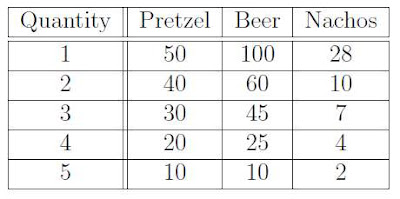
Notice that with each item, they experience diminishing marginal utility (the more they have, the less they want a little bit more).

Based on the above table, how will the consumer spend the first of their $10? It makes sense that they would get "the most bang for their buck" and buy the first beer, which yields 100 marginal utils (as opposed to 50 or 28 for pretzels and nachos, respectively).
Now, how does the consumer spend their 2nd dollar? They could buy their first pretzel (50 more utils), their second beer (60 more utils), or their first nacho (28 utils). Since the second beer adds to their utility at the greatest rate, they will have the second beer.
How about the third dollar? They can buy their first pretzel (50 more utils), their third beer (45 more utils), or their first nacho (28 more utils). With their third dollar, they will purchase their first pretzel. This process continues, of course, so that we can see a break down of how each dollar of spending will occur:
As you can see, with the first $9 they purchased 4 pretzels, 4 beers, and 1 nacho, and are now indifferent on the 10th dollar of spending. On the 10th dollar, the marginal utility is equal across all goods.

See Also: The EMBP in One Picture

Sunday, October 18, 2009

Some Rights are Just Wrong

Granting rights is easy, as this news snipet points out:
Starting next July, every person in Finland will have the right to a one-megabit broadband connection, says the Ministry of Transport and Communications.
Enforcing rights like these without violating other rights, now THAT is quite difficult.

[HT: Kate]

Finding the Interesting Question

Here is the trailer for The Box:

The interwebs seems to think that the movie's premise is an interesting question:
Your family is in a financial crisis. You receive a box with a button inside and you have a choice. If you push the button your family will get 1million dollars BUT someone you don't know gets killed. would you do it?
Actually, I think the interesting variants of the question would be:
What is the minimum amount of money that would convince you to push the button? What are the determinants of this amount (e.g. financial status, etc)?

Suppose you knew someone was offered the opportunity to push the button, what would you be willing to pay them to not push the button? How does this change in the presence of free-riders?

Suppose you could pay to be removed from the population eligible to be killed by the button-pushing. What would you be willing to pay? Note that each person who does pay increases the probability for others of being selected for death. Therefore, a cheaper alternative may be to pay others to stay on the list.
FYI #1: if no amount of money would convince you to push the button, then your answer is infinite.

FYI #2: I expect the movie itself to be boring.

Saturday, October 17, 2009

Types of blog posts we try not to write

As rants go, this is a doozy. Though I'm definitely using this line as often as possible:

In fact, human-caused global warming is well-established science, far better established than any aspect of economics.

It works on so many levels!

Wednesday, October 14, 2009

Large Hadron Collider Update: October 14, 2009

For those that follow the blog especially close, I've provided occasional updates on the progress of the Large Hadron Collider. The best background post is here, other related posts are here, here, and here. The NYT gives an update, and notes that "[i]n December, if all goes well, protons will start smashing together in an underground racetrack outside Geneva..."

The lesson, as always: With government, months means years.

(By the way, that NYT article is interesting insofar that people have written papers describing how the Large Hadron Collider is being sabotaged from the future.

A pair of otherwise distinguished physicists have suggested that the hypothesized Higgs boson, which physicists hope to produce with the collider, might be so abhorrent to nature that its creation would ripple backward through time and stop the collider before it could make one, like a time traveler who goes back in time to kill his grandfather.

Bizarre. The papers which put forth these theories are here and here.)

(Edited: Justin beat me to it!)

Tuesday, October 13, 2009

2009 Gus Rankings: Week 6

Here are this week's Gus Rankings. No change at the top or bottom this week. Virginia Tech gained six points over the weekend and gives a good example of the power of having defeated winning teams. Three of their points came from beating Boston College, but also got single points from victories by Duke, Marshall and Nebraska. Their single loss came to the second team in the rankings, Alabama, and they haven't lost yet. If Virginia Tech had won that game they would have a sizable advantage on the rest of the field.

At this point, it may be worthwhile to look at which conferences seem to be doing the best. I won't provide anything of length at this point, but look at the top 11 teams (3 teams tied for ninth):

SEC: 3
Big 10: 2
Big 12: 2
ACC: 1
Mountain West: 1
Pac-10: 1
WAC: 1

Should be to fun to see how it shifts around once conference play begins. Having more successful conference opponents from top to bottom should rise the tide of all the boats in the conference.

Monday, October 12, 2009

A comment on comments

I have observed for the last several months on blogs that I frequent, most notably Cafe Hayek and EconLog, that a commenter (or commentators) with the handle(s) "Justin R" and "JR" occasionally appear, without any link that helps identify the author. This person is not me. I always leave a hyperlink back to my personal webpage or TPS, and apart from an occasional violation, I leave my full name (Justin Ross). The blog author puts their reputation on the line to some extent when blogging their ideas, and I feel it is most appropriate to do the same when leaving comments, especially if that comment is leveling some kind of criticism.

Congratulations Dr. Ostrom!

With great pleasure I congratulate my colleague Dr. Elinor Ostrom for winning the Nobel Prize in Economics! As one of the co-founders of the Bloomington School of Public Choice, it is well deserved.

Here is a link to The Workshop in Political Theory and Policy Analysis, of which Lin is co-founder and senior research director.

Sunday, October 11, 2009

War and Politics

That's the title of TPS friend Pavel Yakovlev's first book. Here it is at Amazon. Here is the product description:
This monograph is a collection of empirical and theoretical essays on the interplay between political regimes, military spending, and economic growth. Chapter 1 surveys the literature on political regimes, policies they choose and their economic consequences. Chapter 2 examines how democracy and conscription may affect the number of battlefield deaths and the value of a statistical life in military conflicts. Chapter 3 investigates how arms trade and military spending may affect economic growth. Chapter 4 examines the efficiency of political markets and factors influencing political polarization. Chapter 5 summarizes the findings and suggests the avenues for future research.
A semi-spoiler:
The book is based on his dissertation, and one of the more interesting findings that emerge from it is that democracies substitute kapital for labor at a higher rate than dictatorships, as do countries that employ the draft. You can think of countries without a draft being forced to pay market wages for soldiers, and thus substituting to more military machinery, whereas the draft carries the ability to coerce labor at below-market wages.

If you think more elaboration on those ideas would interest you, then do check out the book. Especially if you are a doctoral student interested in conducting similar lines of research.

Disclosure: In compliance with new federal regulations, let it be known that I received no compensation for this review.

Friday, October 09, 2009

File this under: Incentives matter, not taking the escalator

Check out this video from a subway station in Sweden.

Q: How do you get more people to take the stairs?
A: Make it into a piano.

Best Careers

We've talked about best and worst jobs before, CNN Money chimes in with their top 50 careers, based on "great pay and growth prospects." College professor comes in at #3, the top end seems to be laden with health- and technology-related jobs. The way in which these rankings tend to develop rarely involves more than a smattering of consideration, though the opportunity cost of your employment is always fun to consider.

Thursday, October 08, 2009

In-N-Out

Outside of consistently good Mexican food, there's nothing I miss more in the culinary realm by living in the eastern portion of the country than In-N-Out. Nothing compares. Five Guys is passable but a weak substitute.

Why do I bring this up? There's a new book about In-N-Out, and it's here.

Wednesday, October 07, 2009

Inventives Matter: Tax Cheats Edition

From Yahoo News (HT: Jason Oberle):
Dangle some cash and a lot of people are happy to turn in their employers for cheating on their taxes.

Since Congress beefed up whistleblower rewards in late 2006, tips about suspected tax cheats owing at least $2 million have jumped more than tenfold, the Internal Revenue Service said in a report Thursday.

In 2008, the agency received tips on 1,246 suspected tax dodgers, each owing more than $2 million. That's up from 116 big-money tips in 2007.

...

The 2006 law targets high-income tax dodgers, guaranteeing rewards for qualified whistleblowers if the company in question owes a least $2 million in unpaid taxes, interest and penalties. Tips about individuals also qualify if the taxpayer has an income of at least $200,000.


The most interesting part is the last excerpted paragaph, in my view. We don't care about cheating in the abstract, just cheating from firms with more than $2 million in unpaid taxes and individuals with at least $200K in annual income. True, on a case-by-case basis it might not be worth pursing smaller dues. However, these are the groups who will be most inclined to fight the accusations. Furthermore, smaller taxpayers in the aggregate still probably account for a good chunk of change, and excluding them from eligibility does not do much for deterrence of evasion.

My thoughts on tiebreakers in Major League Baseball

I was struck during the pregame show of last night's Twins/Tigers tiebreaker of how often these games end up being particularly competitive. Last night's game was no exception. Last year, the White Sox defeated the Twins 1-0, the Rockies defeated the Padres in an epic 13-inning game the year before that, and even more well known is the Bucky Dent game from 1978 and Bobby Thompson's legendary home run in 1951. Those are all one run games, and with the exception of last year's White Sox/Twins game-- a good game in its own right-- the other four are, independent of circumstance, in the upper one hundredth of one percent of professional baseball game sever played. What is it about tiebreakers that elicit such quality baseball? Furthermore, what is it about one game producing such high quality baseball as compared to a series? Is there something about both teams facing elimination that generates more competitive games?

Here's a list of the 13 tiebreakers that have been played in MLB history. Note that prior to 1978-- so starting with 1962 and heading back in time-- tiebreakers were 3 game series. Counting yesterday's game, there have been 8 one-game tiebreakers. Four of the games were decided by one run, and another had a 2 run difference.

Testable implications: Are Game 5s/7s in series more competitive than the previous games? Of the tiebreaker series that came down to a Game 3, one of them was a 1-run game and another was a 2-run game. I'm not going to count through baseball history, but I wonder how it all stacks up.

Further testable implications: What about other sports?

Possible policy implication: If both teams are faced with the possibility of elimination, and the games are found to be more competitive, and long run commercial interest is a function of competitive nature of important games, would professional sports leagues be well-advised to eliminate series and have a one-game-take-all playoff structure? There's a lot more to consider-- namely, ad revenue declines in a one-and-done scenario (and thus the value of purchasing broadcasting rights to a championship series), as well as cultural issues (mostly with baseball)-- but it's nonetheless worth thinking about. Oftentimes, people like to say that a seven game series is not long enough to effectively separate the better team in baseball. I don't disagree. But if seven's not good enough and there's no prospect for lengthening the series, why not move to one game if the game is likely to be very good?

Interesting note: Football is the only sport that currently lines up as coming down to one game for playoff advancement, and it is clearly the most popular of the four major sports.

Another interesting note: Basketball recently switched from 5 game series in the first round to 7 game series-- thereby reducing the chance of a double elimination game-- and the argument could be made that basketball's popularity in the recent past has declined.

Yet another interesting note: College basketball's playoff structure is one-and-done and is massively popular.

Tuesday, October 06, 2009

“Primacy of Theory” – Hmm. Dan Klein Chimes In

Dan Klein sent me his thoughts on the discussion that has been taking place concerning Human Action. With his permission, I am posting them here:

"Reading Emily’s post, I find myself unsympathetic with her distinction between “economic theory” and “empirical economics” (or “applied economic theory”).

Continued below the fold.
+/-