Family planning authorities in Puning, a city in the southern province of Guangdong, have detained more than 1,300 people in the drive, the Nanfang Countryside Daily said in an investigative report.
Those detained included parents who refused to undergo the surgical procedure and their "relatives", the report said.
[...]
Huang Ruifeng, a 64-year-old father of three, said he was contacted by a local official ordering him or his wife to have the surgical procedure, the Nanfang newspaper said.
Mr Huang refused, claiming he was too busy. Later his father was taken away.
Authorities said they were using "extraordinary measures" to encourage couples to undergo sterilisation, such as refusing to provide the children proper registration documents.
The move effectively denies the children access to public services such as health insurance and free schooling.
Friday, April 23, 2010
China Begins Forced Sterilization of Citizens

Thursday, April 22, 2010
Circumventing International Recognition
At various roadside junctions in central Hargeisa currency vendors sit at battered metal containers piled high with brick-size wedges of Somaliland shillings, US dollars and Euros. Wedged into these stacks of cash are Somali passports.Anyone interested in traveling to the horn of Africa?
“We sell these passports because our government is not recognised, so if we want to do business outside Somaliland we have to use this document”, 26 year old Hussein told me flicking through the front pages of a pristine Somali passport. Adding ones details is no sweat – simply glue a photo over the box that says ‘picture’ and fill in your details by hand. A minister’s signature is required from Mogadishu – if indeed there is a Minister of Immigration -but that is easily circumvented.
“We just forge the signature”, Hussein said nonchalantly.
“And the Somaliland officials turn a blind eye?” I asked. “Of course they do”, smiled Hussein, “They have to travel on these passports too”.
Wednesday, April 21, 2010
Selgin on Free Banking
The fundamental reason why central banks, which are essentially mercantilist institutions, survive today is because they have managed to secure economists' blessing. This blessing in turn reflects economists' tendency to treat monetary instability as a problem inherent to free markets, which only central banking can address, instead of seeing central banks themselves as a principle source of monetary instability, as they might were they to study monetary history more carefully than most do. Consequently economists have come to apologize for government currency monopolies, despite having long condemned such monopolies in other realms, and for good reasons.
Juicing the Mitchell: Birther Conspiracy Edition
White House aides are scoffing at a move in the Arizona legislature to force President Obama to show his birth certificate to get on the state's ballot in 2012 for his likely re-election battle.Actually, I do believe I will be better served by a legislature that is less focused on my life. If that means focusing on any number of trivial pursuits, then so be it.
"This is a question that has been answered exhaustively," White House spokesman Bill Burton told CNN. "I can't imagine Arizona voters think their tax dollars are well served by a legislature that is less focused on their lives than in fringe right-wing radio conspiracy theories."
Monday, April 19, 2010
What is Inflation?
The latest country to fall to hyperinflation was Zimbabwe, where inflation rate reported to be at 89.7 sextillion (10^21) percent in 2008, about 14% increase in prices daily.Ouch. I didn't even know 'sextillion' was a unit.
[HT: Astrid]
Tax Day Tea Party Talk
+/-
Residents Refuse FEMA Buy Out
I'm fine with people who knowingly wish to remain in flood prone areas, but this highlights the dynamic problems of getting the government in the business of this particular type of bail out.
The Historical Complexity of Federal Public Finance
Looking at it in piecemeal, starting with the 1790's:
 What is interesting is just how simple it all is. Expenditures are primarily devoted towards expenditures on military/national defense, as well as interest on debt. There are 3 categories for revenue (customs, excise, and direct). Now, looking at 1866-1879 expenditures:
 The expenditure categories are still very basic and focus on military and interest on debt. The category "Indians" now appears, and my guess is that this is basically a military expense as well. The "Miscellaneous" category is further broken down, and it appears to mostly consist of administrative expenses in taxation, "postal deficiency" (?? Too good to be true, there must be a different meaning here), the provision of lighthouses, printing money, and public buildings (to some extent, another administrative expense).
Now, the revenue side:
 So, revenue sources appear to have grown in categories, but my guess is that this reflects changes in the economy over the ensuing century and improved administrative infrastructure more than anything else. It does appear, however, that revenue collection became more complex at a faster rate than expenditure patterns over the inaugural century. Is there a reason we should expect this? My guess is that this reversed after the Great Depression, but I wonder what it would have looked like in the 1920's.
Here is the webpage devoted to modern government revenue and expenditure categorization.
Emily Schaeffer on Greater Freedom
Saturday, April 17, 2010
Blockquoting X
The jury, as an institution, is an instrument designed to fascilitate the discovery process. If it is efficient, as an institution, it may be the best available means of ascertaining judgements of guilt or innocence in situations in which one or the other of these verdicts is socially required.
Thursday, April 15, 2010
Today's Juicing the Mitchell
Public Safety through Private Action
Given the central role of private individuals and firms in determining the effectiveness of the criminal justice system, and the quality and availability of criminal opportunities, private actions arguably deserve a central role in the analysis of crime and crime prevention policy. But the leading scholarly commentaries on the crime drop during the 1990s have largely ignored the role of the private sector, as have policymakers. Among the potentially relevant trends: growing reporting rates (documented in this paper); the growing sophistication and use of alarms, monitoring equipment and locks; the considerable increase in the employment of private security guards; and the decline in the use of cash. Private actions of this sort have the potential to both reduce crime rates and reduce arrests and imprisonment. Well-designed regulations and programs can encourage effective private action.
One creative method to harness private action to cost-effective crime control is the creation of business improvement districts (BIDs). Our quasi-experimental analysis of Los Angeles BIDs demonstrates that the social benefits of BID expenditures on security are a large multiple (about 20) of the private expenditures. Creation and operation of effective BIDs requires a legal infrastructure that helps neighborhoods solve the collective action problem.
Wednesday, April 14, 2010
What I've Been Reading
The following is the epigraph (translated) and sums it up nicely:
And it is fortunate for men to be in a situation in which, though their passions may prompt them to be wicked, they have nevertheless an interest in not being so.
I'm drawn to the idea of the interplay between economic interests and political interests; oftentimes we think of the latter harming the former, but this book explores the interaction going the other direction. It's a hidden virtue of capitalism that seems to have been lost, as the author argues, around the time of Adam Smith.
Thursday, April 08, 2010
iPad Middlemen
On Saturday, Leung and dozens of his friends stood in line at Apple stores around the San Francisco area. "We were limited to buy only two apiece," he said on Wednesday, toting a suitcase filled with iPads fresh off a plane from San Francisco and ready for resale on the streets of Hong Kong.
All told, he and his friends brought back about 200 iPads for sale in Hong Kong, where stores were selling them for as much as 60 percent higher than their $499 retail price.
Note also the individual looking to extend the process to China.
Wednesday, April 07, 2010
Libertarian Paternalism @ CATO Unbound
Consider the following common problem. Most firms have an open enrollment period in November when employees can elect their benefit package for the following year. At my employer, the University of Chicago, you have a few weeks to log on to the appropriate web site and make your selections. The question is, what should the employer do for those employees who forget to log on? (Professors’ reputations for absent-mindedness are well deserved.) For each of the choices the employee has, the employer needs to select a default option for those who do not log on, and normally the default is either “same choice as last year” or “back to zero” (meaning, decline this option). At Chicago the default option for the health insurance plan is the same as last year.It's hard NOT to support this version of Libertarian Paternalism (of course, I'd prefer the choice architect be a private entity). If a default must be set, one should (in my normative opinion--and apparently Thaler's and others') set the default to what would most likely make the participant best off.
Of course it is possible to criticize this choice of the default option, but it is essential to understand that the employer must choose something. Some employers use “back to zero,” which minimizes the costs to the employer; somewhat less drastic would be to default employees into the plan that is cheapest for the employer; one could even choose a default plan at random (don’t laugh — this is the strategy used for some participants in the Medicare Part D prescription drug coverage implemented by the Bush administration); or the employer could somehow force employees to make a choice. The Nudge philosophy here is that the person who designs the plan, whom we call the choice architect, should choose the default that she thinks, all things considered, will make the participants best off. Does Professor Whitman have a better suggestion?
It seems, however, that this is a very narrow subset of the LibPat agenda. Typically, the government (not the employer) is the choice architect. And when the employer IS the choice architect (say in that cafeteria/fruit example) the government intervenes as supreme default-setter. Nudging is transformed from an ethical guideline that individuals should employ to a government mandated policy. Yet Thaler and others continue to present the very narrow subset of LibPat as the whole agenda. Is my perception of the debate correct? Or have I missed something?
Tuesday, April 06, 2010
Yardstick Competition in School District Income Tax Adoption
Previous research has shown that Tiebout-style fiscal competition among local governments reduces the likelihood of adopting income taxes. This literature has not yet considered the impact of yardstick competition on tax instrument choice. This paper employs spatial econometrics to test for yardstick competition in the decision to adopt an income tax. The results, based on Ohio school district data, indicate that school districts are more likely to adopt an income tax if their neighbors have already done so. While a negative correlation of Tiebout competition on district income tax adoption persists, controlling for spatial dependence reduces the statistical significance of the effect.
Monday, April 05, 2010
Onion Nails Levitt-style Thinking
A University of Chicago freakonomics professor told General Electric investors Monday to keep a close eye on recent fluctuations in the heights of competitive powerlifters from Mexico. "Usually we can count on a stable average of 5 feet 8 inches, but last month's quarter-inch drop in height among Mexican dead-lift competitors in the middle-heavyweight division could spell disaster for GE's aviation and software subsidiaries," freakonomist James Duncan said. "But, like anything else, a shrewd investor must always ask himself one thing: How many hot dogs did I eat last year?" Duncan previously gained recognition for tracking first-time home ownership and teenage mothers' gum purchases against the Times Tom Jones Is Played Per Day Index.[HT: Omar]
SPEArt

Beer, nachos, and pretzels. TPS readers also might recognize the example.
I won the auction with a bid of $50, a bargain at twice the price!
Improvement through art
Instead, they suggest, it's a natural consequence of "dramatic socio-historic increases in the production, availability, safety, abundance and affordability of food" over the millennium that started in the year 1000 A.D.
Indeed.
Thursday, April 01, 2010
Warning: Overpopulation Could Cause Tipping
It should be noted that Congressman Johnson has been battling Hepatitus C. From the AJC:
The Lithonia Democrat's already-thin frame has shed 30 pounds in the past year. His speech is slower than ever, and he regularly gets lost in thought in the middle of a discussion. He is easily fatigued and often impatient and irritable.It seems to me that Johnson is unfit to serve as Congressman. Rather than ousting him, though, I suggest a full scale investigation. What bills has he authored, supported, and voted for? How is his illness affecting other congressmen? What are his children doing these days? Let's get to the bottom of this!
[...]
He was officially declared free of the virus in January, but it has ravaged his liver, resulted in thyroid problems and other health issues, including depression, for which he's also being treated. To keep the disease in remission, Johnson is going through an experimental treatment that he said has been the worst part so far.
Wednesday, March 31, 2010
Recommended Reading for Isreali Lawmakers
An Israeli lawmaker is hoping to butter up voters and pass a law that would limit outrageous popcorn prices at the movies.Carmel Shama, from the governing Likud party, plans to bring the "popcorn law" for a vote when parliament returns from its Passover break next week, the mass-selling Yediot Aharonot newspaper reported Wednesday.
"We have to put an end to this. The public should not have to mortgage their houses for a soft drink and a snack," Shama told the paper.
Tuesday, March 30, 2010
The Pursuit of Justice: The Law and Economics of Legal Institutions

The editor is San Jose State economist and DOL blogger Ed Lopez. You can buy the book here. I haven't read it, but I had the pleasure of sitting in on a West Virginia University seminar with Ed several years ago when it was still in the editing phase and found it fascinating. I have never been able to take seriously the show CSI since that time. Here are the Table of Contents:
An Introduction to the Pursuit of Justice--Edward J. Lopez
The Rise of Government Law Enforcement in England--Nicholas Currott
Electoral Pressures and the Legal System: Friends or Foes?--Russell S. Sobel
Romancing Forensics: Legal Failure in Forensic Science Administration--Roger G. Koppl
Judicial Checks on Corruption--Adriana Cordis
Effects of Judicial Selection on Criminal Sentencing--Aleksandar Tomic
Economic Development Takings as Government Failure--Ilya Somin
On the Impossibility of “Just Compensation” When Property is Taken--John Brätland
The Lawyer-Judge Hypothesis--Benjamin H. Barton
Class Action Rent Extraction--Jeffrey Haymond
Cy Pres and its Predators--Charles N. W. Keckler
Licensing Lawyers: Failure in the Provision of Legal Services--Adam B. Summers
(And No Uncle Sam, I got nothing for this post.)
Large Hadron Collider Update: March 30, 2010
There should be some interesting results, though the lesson, as always, is to think in terms of net benefits, not gross benefits.
And yes, this was only a matter of time.
Monday, March 29, 2010
Blockquoting X
[...] whatever may have been the history of gold, at the present time, in a normally well-working economy, money is a creature of the state. Its general acceptability, which is its all-important attribute, stands or falls by its acceptability by the state.
Sunday, March 28, 2010
Working Paper: BRACE for the New Interventionist Economics
The Great Recession seems to be creating a New Interventionist Economics characterized by bubbles, radical uncertainty, animal spirits, complexity dynamics, and extra-market control. When placed in that order, these characteristic create the acronym BRACE. We review some evidence and literature pointing to BRACE economics and briefly suggest some avenues to challenge the new interventionists.The full version is available via SSRN.
Saturday, March 27, 2010

Friday, March 26, 2010
Skarbek Accepts Offer at Duke
Wednesday, March 24, 2010
Landsburg and Counterfeiting
In case it is not obvious, Landsburg’s standard of morality is economic (Kaldor-Hicks) efficiency. “Certainly not” is a strong statement, and Will, who has done some interesting work on the subject of counterfeiting, asked some insightful probing questions. I asked a follow-up question: “Is it okay to counterfeit if the central bank is not being sufficiently expansionary?”In addition to being an incredible (and incredibly clear) writer, Landsburg is one of the nicest academics I've met. (Academic economists admittedly establish a low bar. Landsburg is a nice guy by much higher standards.) In conversation after the talk, we agreed that the morality (his word) of counterfeiting depends on whether one believes price adjustments are costly.
Landsburg looked at me skeptically. “Are you going to keep the seigniorage?” he asked. “Sure. That’s just a distributional question,” I replied. Landsburg thought for a second, smiled, and very graciously admitted he did not have an answer.
In honor of the Census postcard, following the Census letter, notifying me of the forthcoming Census form
| Futurama | Weeknights, 9p/8c | |||
| Bureaucrat's Joy | ||||
| ||||
My Fiscal Debt Prediction
My own guess is that the United States will raise taxes substantially, and taxes will reach levels as a percentage of GDP never seen in U.S. history (although common in Europe). The politics of that will be fascinating to watch. If the political process is stymied as our leaders debate the relative merits of tax hikes versus spending cuts, bond investors may get nervous, and we could get witness either the Krugman inflation scenario or the much less likely default scenario.I actually see the default scenario as the most likely out, perhaps because my guess of what future tax rates will have to look like are higher. Not only do I expect them to be higher than in Europe, but more importantly I expect Americans to be far more disdainful of higher tax rates to pay off the previous generation's debt. I could see a lot of Americans accepting high taxes for European-level services, but that's not what they would be getting.
Note that I am certainly not making an economic argument, but a political forecast, which is well outside the domain of my expertise.
Tuesday, March 23, 2010
Blockquoting X
It takes a profound ignorance of science to believe that God created the world six thousand years ago. It takes an equally profound ignorance of economics to believe that protectionism--the use of quotas and tariffs to discourage the importation of foreign goods--can make us more prosperous.
It's true that a small number of working scientists manage to embrace some form of creationism, and a small number of working economists manage to embrace some form of protectionism--but in each case we're talking about tiny (though sometimes vocal) minorities. The vast majority of the time, scientific knowledge precludes creationism and economic knowledge precludes protectionism.
There's a difference, though: The case against creationism relies largely on facts about the fossil record and geologic strata, while the case against protectionism relies primarily on logic. The facts that refute creationism are discovered and reported by scientists; the rest of us have to take it on faith that those scientists are being truthful. By contrast, the logic that refutes protectionism is available for anyone to evaluate from scratch.
Therefore it seems to me that the protectionist's position is even less respectable than the creationist's. If you're convinced that most scientists are liars--that everything they say about fossils, for example, is false--then you can be a logically consistent creationist. But you can't be a logically consistent protectionist (p. 51).
Monday, March 22, 2010
Markets in Everything: Purse Theft Insurance
Friday, March 19, 2010
Blockquoting X
A central bank and a gold standard are incompatible, if the central bank is actually doing anything. [...] By and large it's the case, as Thomas Hobbes put it, if two men ride on a horse, one has to ride in front.
Best Morning Sentence
And it helped me understand the difference between trying hard to honestly think through tough social problems because you care and mouthing comfortable pieties in an effort to get credit for caring.
Monday, March 15, 2010
Blockquoting X
It is at least conceivable, though unlikely, that an autocratic government will exercise self-restraint; but an omnipotent democratic government simply cannot do so.
Central Bank Reform
This paper is a first empirical attempt to investigate why politicians around the world have chosen to give up power to independent central banks, thereby reducing their ability to fine-tune the economy. A new data-set covering 132 countries, of which 89 countries had implemented such reforms, was collected. Politicians in non-OECD countries were more likely to delegate power to independent central banks if their country has been characterized by a high variability in historical inflation and if they faced a high probability of being replaced. No such effects were found for OECD-countries.You can find the full version here.
Thursday, March 11, 2010
Questions: On Food Taxes to Fight Obesity?
According to a new study published in the Archives of Internal Medicine, increasing the price of soda by 18 percent would result in a decrease in overall sales, leading to fewer calories a day for regular soda-drinkers.For years, nutrition experts have recommended a federal tax on soda and other sugary drinks to cut consumption of high-calorie, unhealthy drinks and to help obese Americans lose weight.
Just for the sake of argument, let's accept the following propositions as being true: An obese individual confers a negative externality upon others. Taking this as a given, here are my questions:
- Why is it to be believed that the obese (or potentially obese) are unaware of the social consequences of their weight? This explanation is necessary to justify an obesity motivated tax on Pigouvian grounds.
- How would you reconcile this argument with the near universal view that society places too much emphasis on body image?
Tuesday, March 09, 2010
We Told You So
Here is Paul Krugman in praise of cheap labor.
Tourney Predictions
Naturally, I wondered how accurate these predictions end up being. There are four smaller brackets of sixteen teams each and, all put together, there are 65 teams invited to the tournament (there is a play-in game for one of the 16-seed lines). That means four 1-seeds, four 2-seeds, etc., all the way though the 16-seeds. So the question was: How accurate is Joe Lunardi?
Naturally, whenever I have sports questions, I fire an email to TPS Sports Correspondent Rob Holub, and he sent along the following (excellent) assessment of bracket guesses.
It turns out there's a lot more people besides Joe Lunardi guessing! But there's something I found interesting in that rundown. Note that every guess is scored and then compared to the others within that year. Some years may be harder than others to figure, so the variance calculation controls for that. But note the variance of the variance-- the dispersion of within year performance by guesser. Ultimately, people don't consistently perform better (or worse) than average. To be certain, when you average these variances, you can generate an order of who has done best-- you can argue about how appropriate a simple mean is for determining the most successful guesser from the underlying ratings, as well as the scoring matrix in the first place, but it's a legitimate first stab at the issue-- but outside of a few individuals, most people have comparatively successful years followed immediately by comparatively unsuccessful years. The range within each guesser is generally over 10, and (just glancing) more often than not over 20.
How to account for that?
- The NCAA Selection process is notoriously secretive, though strides have been made in recent years to try and provide a bit more clarity to the process. (Individuals have been invited to mock selection meetings, though I don't have any links at the moment.) Could it be that there's a degree of information concerning the selection process that can never be incorporated? If the selection process remained the same from year to year-- namely, standards for selection into the tournament and the individuals making the decisions-- then this information should be accessible. Yes, teams and the distribution and nature of performance changes year to year, but so long as the standards stay the same, this shouldn't matter in the long run. The problem, as I see it, is that standards may stay de jure similar, but the individuals making the decision change, and the former is necessarily a function de facto of the latter. So as long as new people as continually cycled into the selection process, there may be reason to believe that there's a degree of uncertainty that can't be overcome (and if we believe the previous calculations, it could be a significant amount).
- The bracket itself is very sensitive to errors. In theory, you could have seeded every single team correctly yet have none of the match-ups correct. Also, you could have correctly identified every team selected for the tourney but actually earn zero points according to this ranking system. This could be a factor for the large dispersion in variance-- very minor errors can lead to big point differences.
- As a side note, I am curious if there is a betting market for bubble teams-- teams on the cusp of making or not making the tourney-- and I'm curious how well they incorporate information as the time gets closer. (Though that's not exactly what the above rankings measure.)
Any further thoughts?
Monday, March 08, 2010
Who Issued that Toyota Recall?
The fact that the November 2009 recall of 3.8 million vehicles was initiated by Toyota — while the National Highway Traffic Safety Administration declined to reopen a closed investigation into potential Toyota defects — highlights the private sector's incentive to compensate for perceived problems. Worldwide voluntary recalls on the part of Toyota confirm this.That of course, is TPS blogger Emily Schaeffer.
One unintended consequence of Congress parading Toyota executives around for political gain is that they are probably more likely to discourage the future discovery of problems rather than incentivize their up-front correction (on the margin, of course).
Friday's Radio Spot
Saturday, March 06, 2010
Professor fired over facebook status
From ABC News (HT: Jason Oberle):
Gloria Gadsden, a sociology professor at East Stroudsburg University in Pennsylvania, says she was suspended last week after updating her Facebook status with complaints about work that alluded to violence.
In January, she wrote: "Does anyone know where I can find a very discrete hitman? Yes, it's been that kind of day…" Then in February: "had a good day today. DIDN'T want to kill even one student. :-). Now Friday was a different story."
Gadsden says she posted the comments in jest, on a profile she thought could only be seen by friends and family. She says officials were notified of the posts by a student -- even though she says she had no students in her "friend" list.
Friday, March 05, 2010
My Favorite Negative Book Review
This awful autobiography is mostly about conspiracies orchestrated by the U.S. corporatocracy and the troubled global economy. John Perkins writes in an absurdly comical way, offering at the outset that this "is a true story" that "must be told" (p. x). Whether it is worse on the conspiracy or economy dimension is not obvious. A more worthy question that I'll address later is how Confessions became a New York Times best seller.The whole review is worth reading. Confessions is not.
Thursday, March 04, 2010
Blockquoting X
While it is sensible to supplement the commands determining an organization by subsidiary rules, and to use organizations as elements of a spontaneous order, it can never be advantageous to supplement the rules governing a spontaneous order by isolated and subsidiary commands concerning those activities where the actions are guided by the general rules of conduct. This is the gist of the argument against 'interference' or 'intervention' in the market order. The reason why such isolated commands requiring specific actions by members of the spontaneous order can never improve but must disrupt that order is that they will refer to a part of a system of interdependent actions determined by information and guided by purposes known only to the several acting persons but not to the directing authority. The spontaneous order arises from each element balancing all the various factors operating on it and by adjusting all its various actions to each other, a balance which will be destroyed if some of the actions are determined by another agency on the basis of different knowledge and in the service of different ends.
Wednesday, March 03, 2010
Commenter Accountability
Also, Santiago (with over a third of Chile's population) has an odd, privately-owned public transportation system, where drivers own their own buses and keep their fares. This has been nothing short of disaster -- inefficient, as every bus route goes through the crowded center, more profitable than operating more efficient feeder routes, leading to hundreds more buses clogging the streets than are needed; dangerous, since bus drivers race each other in competition for passengers (I have personally been on a bus that hit a pedestrian and didn't stop, as well as in a car that was hit by a bus which didn't stop); polluting, since drivers have plenty of incentive to keep old, broken buses on the road rather than buying new ones; and not even really privatized since all of the dozens of bus companies raise fares simultaneously (and also band together for strikes against attempted governmental interference). If there was ever a place for central planning, it's here."neil" got his wish, and how did that turn out?
Posted by: neil at Dec 20, 2006 12:22:39 PM
Snow and Parking in Pittsburgh
What's fun about it? It's totally unplanned. Most people respect the fact that if you dig out a parking space, you should enjoy the fruits of your labor. So, people leave a chair or a laundry hamper to show intent to return and use the space. By in large, this system seems to work pretty well here. I get a kick out of seeing assorted wares near the side of the road, but I haven't heard anyone complain about it. (Unlike my neighbors.) Incentives fall to dig out the space if the space can be occupied when you return (though I think the effect is smaller than at first glance). All in all, it's nice to see what people can work out for themselves-- and remember, if the city government were effective at removing snow, this practice would not have evolved in the first place.
Why talk about it now? One municipality here, Dormont, has decided it's gone far enough. Starting today, anyone that leaves an item in the road will have that item removed.
It's government against social norms here in Pittsburgh! Situations like these generally don't have clean outcomes.
Tuesday, March 02, 2010
Do Econ Majors in Congress Vote Against the Minimum Wage?
Much has been made about the lack of economic education among the public at large, yet little has been said about the limited education of Members of Congress. This paper examines the economic education levels of Members of Congress voting on the 2007 increase in the minimum wage. Controlling for a variety of characteristics of members and constituents, this study finds that members who majored in economics as undergraduates were less likely to vote for the minimum wage increase than their colleagues. No other major had a consistent influence. A large number of statistical specifications confirm the robustness of the finding.
"Economists are Rude"
The subject of the talk, however, is the always interesting Bill Fischel on the history of school district formation. The underlying theme is contrasting the various views on why school district consolidations took place, one being that it was driven by the enlightened elite compared to the view that it was driven by competition in local public goods:
You can find Fischel's most recent book on schools and local government here.
Global Warming Update
Put the errors together and it can be seen that one after another they tick off all the central, iconic issues of the entire global warming saga. Apart from those non-vanishing polar bears, no fears of climate change have been played on more insistently than these: the destruction of Himalayan glaciers and Amazonian rainforest; famine in Africa; fast-rising sea levels; the threat of hurricanes, droughts, floods and heatwaves all becoming more frequent.
All these alarms were given special prominence in the IPCC's 2007 report and each of them has now been shown to be based, not on hard evidence, but on scare stories, derived not from proper scientists but from environmental activists. Those glaciers are not vanishing; the damage to the rainforest is not from climate change but logging and agriculture; African crop yields are more likely to increase than diminish; the modest rise in sea levels is slowing not accelerating; hurricane activity is lower than it was 60 years ago; droughts were more frequent in the past; there has been no increase in floods or heatwaves.
A smattering of our posts on climate change here, here and here.
Monday, March 01, 2010
African Poverty
The conventional wisdom that Africa is not reducing poverty is wrong. Using the methodology of Pinkovskiy and Sala-i-Martin (2009), we estimate income distributions, poverty rates, and inequality and welfare indices for African countries for the period 1970-2006. We show that: (1) African poverty is falling and is falling rapidly; (2) if present trends continue, the poverty Millennium Development Goal of halving the proportion of people with incomes less than one dollar a day will be achieved on time; (3) the growth spurt that began in 1995 decreased African income inequality instead of increasing it; (4) African poverty reduction is remarkably general: it cannot be explained by a large country, or even by a single set of countries possessing some beneficial geographical or historical characteristic. All classes of countries, including those with disadvantageous geography and history, experience reductions in poverty. In particular, poverty fell for both landlocked as well as coastal countries; for mineral-rich as well as mineral-poor countries; for countries with favorable or with unfavorable agriculture; for countries regardless of colonial origin; and for countries with below- or above-median slave exports per capita during the African slave trade.
Note #3 from the abstract-- a popular (ill-guided) concern over African growth is that income inequality will result, and that's bound to cause problems. The latter is debatable, but the former isn't the case.
Thursday, February 25, 2010
Unions vs. School Districts: Rhode Island edition
The Art of Not Being Governed
"In one sense, the difficulty of moving grain long distances, compared with the relative ease of human pedestrian travel, captures the essential dilemma of Southeast Asian statecraft before the late nineteenth century.
...
Imagine a map constructed along these lines, designed to represent relative degrees of potential sovereignty and cultural influence. One way of visualizing how the friction of distance might work is to imagine yourself holding a rigid map on which altitudes were represented by the physical relief of the may itself. Further, let's imagine that the location of each rice-growing core is marked by a reservoir of red paint filled to the very brim. The size of the reservoir of paint would be proportional to the size of the wet-rice core and hence the population it might accommodate. Now visualize tilting this map...
The angle at which you had to tilt the map to reach particular areas would represent, very roughly, the degree of difficulty the state would face in trying to extend its control that far."
That's from the terrific The Art of Not Being Governed by James C. Scott, I'm working my way through it.
Tuesday, February 23, 2010
Expiration Dates as Self-Regulation
Such disparities are a consequence of the fact that, with the exception of infant formula and some baby foods, package dates are unregulated by the federal government. And while some states do exercise oversight, there's no standardization. A handful of states, including Massachusetts and West Virginia, and Washington, D.C., require dating of some form for perishable foods. Twenty states insist on dating for milk products, but each has distinct regulations. Milk heading for consumers in Connecticut must bear a "Sell by" date not more than 12 days from the day of pasteurization. Dairies serving Pennsylvania must conform to 14 days.So in actuality, the meaning of the date is a very complex phenomenon that is specific to the individual traits of the food and the intended quality level, and yet it is one that we seem to work with very well.That dates feature so prolifically is almost entirely due to industry practices voluntarily adopted by manufacturers and grocery stores. As America urbanized in the early 20th century, town and city dwellers resorted more and more to processed food. In the 1930s, the magazine Consumer Reports argued that Americans increasingly looked to expiration dates as an indication of freshness and quality. Supermarkets responded and in the 1970s some chains implemented their own dating systems.
The Slate writer sees this all as a problem that needs to be fixed, while acknowledging that people seem pretty good at deciding when their food is good to eat. She also raises concerns about the next E. coli outbreak, but last I checked those (as seldom as they are) are probably even less likely to originate from you not throwing your milk away sooner.
Saturday, February 20, 2010
Shifting Coalitions?
To simplify, we can think of the GOP at present as being comprised of three groups: neocons, traditional conservatives, and neoliberals. Neocons are in favor of interventionism, both home and abroad. Traditional conservatives support free markets, but also support "traditional conservative values" and don't mind using the state to enforce said values. Neoliberals are in favor of free markets and, even though some may share the conservative values of their traditional conservative allies, they do not advocate using government power to legislate those values. I do not see the neoliberals and neocons finding common ground. So the question is: will traditional conservatives downplay their state-supported values in order to side with neoliberals or reject their free market stance in order to side with neocons?
The sides have been drawn but it isn't clear how things will end. Consider these two videos from CPAC.
It should be interesting.
Friday, February 19, 2010
Why Didn't Springfield Get Richer?

Because the dome was just like a policy that rhymes with "Shromectionism."
Inspired by Art Carden's excellent Simpson's image heavy presentation for the students of SPEA.
Wednesday, February 17, 2010
Closing State Deficits
Monday, February 15, 2010
A Plea for Economic Freedom: Gilmore Girls Edition
It goes on, but you get the idea.LUKE: I look at a thousand apartments, I choose yours. How is that possible?
TAYLOR: Well, count yourself lucky, you. With me as the owner, there is a level of quality control that is sorely lacking in this town. For example, at all my properties, we measure the grass before, during, and after mowing to attain a perfect inch and a half height, which is both pleasing to the eye and good for the grass.
LUKE: All of your properties?
TAYLOR: Ten in all.
LUKE: Ten properties? What are you, buying up the town?
TAYLOR: Not yet, but someday – who knows?
LUKE: But why isn’t anyone stopping you?
TAYLOR: Because, my friend, people are lazy. They don’t wanna think about the proper fabric for an awning or the correct historical color for a building. They just slap any old thing up on a wall and sleep like babies. But soon, hopefully, the city council will put an end to that.
LUKE: Taylor, you cannot tell people what color to paint their buildings!
TAYLOR: Well, someone has to.
LUKE: No, they don’t. We don’t live in a fascist country.
TAYLOR: Oh, this isn’t about the fascists – who, by the way, had their faults but their parks were spotless.
LUKE: I have to get out of here.
Blockquoting X
Nowhere is the difference between the reasoning of the older liberalism and that of neoliberalism clearer and easier to demonstrate than in their treatment of the problem of equality. The liberals of the eighteenth century, guided by the ideas of natural law and of the Enlightenment, demanded for everyone equality of political and civil rights because they assumed that all men are equal. God created all men equal, endowing them with fundamentally the same capabilities and talents, breathing into all of them the breath of His spirit. All distinctions between men are only artificial, the product of social, human—that is to say, transitory—institutions. What is imperishable in man—his spirit—is undoubtedly the same in rich and poor, noble and commoner, white and colored.
Nothing, however, is as ill-founded as the assertion of the alleged equality of all members of the human race. Men are altogether unequal. Even between brothers there exist the most marked differences in physical and mental attributes. Nature
never repeats itself in its creations; it produces nothing by the dozen, nor are its products standardized. Each man who leaves her workshop bears the imprint of the individual, the unique, the never-to-recur. Men are not equal, and the demand for equality under the law can by no means be grounded in the contention that equal treatment is due to equals.
Still Hope for Indiana Polycentricity
Still, a lack of direction hasn’t stopped chatter about nixing township government. Legislators have narrowed the number of possible solutions to about three: abolishing township government completely, getting rid of township boards but keeping elected trustees in each township or letting a voter referendum decide on the changes. But perhaps the most intractable problem for state leaders seems to be finding a solution that fits the needs of all 1,008 townships in the state.Yes, a Pareto-improving state policy for >1K entities probably will be a challenge.
The Market for Fake Job References
Schmidt is the founder of CareerExcuse.com, a Web site that says it will fill any gap on your résumé by acting as your past employer. It will go as far as creating a new company with an accompanying phone number, logo, Web site and LinkedIn profile. He says the site is designed to "help our subscribers meet the needs of the modern day job market."
It's an interesting service-- since signal extraction is increasingly difficult with letters of recommendation, my suspicion is that while it won't tip the scales in anyone's favor it may get someone in the door. Further, the downside risk is virtually nil; if your choice is a bad (or less than stellar) recommendation or purchasing a fake one, the consequences of the latter if found out is likely the same as the former-- you just don't get the job. Hiring is already a costly process and I don't see employers shouldering the effort of generating a network to blacklist fakes.
These would seem to work best for entry to mid-range jobs; high end positions are likely to be had through networking and networking (as far as I know) can't be purchased.
CareerExcuse is balancing an interesting line; vast success may overwhelm their ability to stay away from the public eye.
Sunday, February 14, 2010
Blockquoting X
In England it becomes every day more and more the custom to send young people to travel in foreign countries immediately upon their leaving school, and without sending them to any university. Our young people, it is said, generally return home much improved by their travels. A young man who goes abroad at seventeen or eighteen, and returns home at one and twenty, returns three or four years older than he was when he went abroad; and at that age it is very difficult not to improve a good deal in three or four years. In the course of his travels he generally acquires some knowledge of one or two foreign languages; a knowledge, however, which is seldom sufficient to enable him either to speak or write them with propriety. In other respects he commonly returns home more conceited, more unprincipled, more dissipated, and more incapable of any serious application either to study or to business than he could well have become in so short a time had he lived at home. By travelling so very young, by spending in the most frivolous dissipation the most precious years of his life, at a distance from the inspection and control of his parents and relations, every useful habit which the earlier parts of his education might have had some tendency to form in him, instead of being riveted and confirmed, is almost necessarily either weakened or effaced. Nothing but the discredit into which the universities are allowing themselves to fall could ever have brought into repute so very absurd a practice as that of travelling at this early period of life. By sending his son abroad, a father delivers himself at least for some time, from so disagreeable an object as that of a son unemployed, neglected, and going to ruin before his eyes.
Thursday, February 11, 2010
Robin Hood Tax
1. Though the page is vague about the issue, the tax would likely not be instituted by all countries evenly. Therefore, if this campaign has any success, you'll have some countries that incorporate it and some that don't. Financial transactions are *very* mobile-- as mobile as it gets-- and it would be very easy for those who would be taxed to simply move to a locale where the transaction would not be taxed. People want to avoid taxes and this one would be easy to avoid.
2. The tax seems to target "speculative" activity. Depending how you slice it, just about any financial transaction could be classified as speculative-- so there's an issue of exactly what you tax. Further, due to different financial instruments, you can generally replicate one financial transaction through a combination of others. So that could be another way to avoid the tax.
3. As always, there are deadweight loss issues concerning taxation, though some of the effects are described above. Though if you really want to split hairs, those effects described above are technically excess burden, not deadweight loss.
4. As always, the ability of governments to effectively use tax money to generate positive outcomes is dubious at best.
5. As always, there are political problems inherent in taxation in general.
Anything else? 2 would seem to be the short run outcome, 1 would be the long run.
Wednesday, February 10, 2010
My Interview on Pittsburgh Business Radio
North Korea Documentary
But this guy with our group who was from the L.A. Times told us, "Everyone in here besides us is secret police. If you don't act excited then you're not going to get your visa." So we got drunk and sang songs with the girls. The next day we got our visas. A lot of people we had gone with didn't get theirs.By the way, my new favorite oxymoron is "communist self-reliance."
[...]
Perhaps the weirdest thing about North Koreans is that they genuinely don't seem to know that the rest of the planet hates and fears them. They believe (or maybe they really convincingly lie about believing) that the whole world admires and envies them and that they're the true light of socialism and Juche, which is their leader's philosophy of Communist self-reliance.
Tuesday, February 09, 2010
The Mileage Tax and the Efficient Allocation of Outrage
I agree that if your target is the reduction of environmental externalities (pollution and congestion), the fuel tax is sensible and the mileage tax is generally not. However, the history of the fuel tax (Hoover, Revenue Act of 1932; see this rather bizarre report from the US DOT) was a means of raising revenue to finance the expansion of public infrastructure.
To this day, it is a common example in public finance as a program that imperfectly follows the benefit principle of taxation. Those who drove on highways also tended to use gasoline, and hence those who benefited from the infrastructure were the ones financing it. The externality argument, as far as I can tell, came long after the 1932 act establishing the gas tax.
Conditional on the government both producing infrastructure and raising taxes to finance it, shouldn't the preference be for benefit principle taxation? So my basic suggestion is that, on the margin, libertarian outrage is better directed at other subjects, or at least at different angles of the mileage tax (privacy concerns, e.g.).
Return to Barter?
I have hundreds of PHISH cassette tapes and a boombox. They are ALL yours if you shovel my car out of the snow. It`s not a driveway. Just a small parking area. All you have to do is shovel out the left side of the car and the back of the car. If you`re interested please get in touch with me. Thanks.I think this clearly illustrates the coincidence of wants problem. I cannot imagine this transaction was successful.
[HT: Astrid]
Friday, February 05, 2010
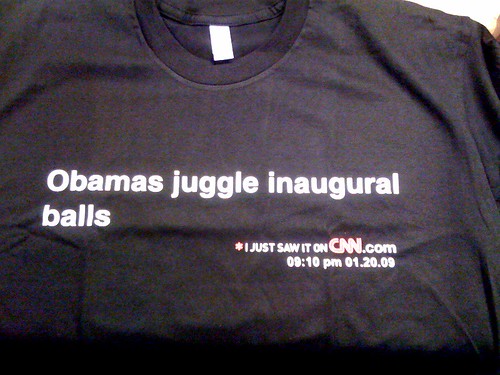
I'm guessing CNN...
It's too bad CNN doesn't do headlines on t-shirts anymore; then again, I think I made out pretty well before it was all said and done (mine's in red).
A Degree In Growing Pot
The CNN reporter is pretty absurd in the coverage, at one point asking the Pot Grower about the development of clean energy for economic growth instead of legalizing pot. Nevertheless the story includes some of the interesting contradictions in Michigan law. You just kind of have to see it for yourself.
Air Marshalls
Though the FAMS program is secretive of assignments by design, I'd love to get my hands on the air marshalls data and see what comes of it.
Wednesday, February 03, 2010
Free (Baseball) Data
Of course I will be happy if someone extends the work, but it might also be a convenient dataset for students interested in baseball who are also looking to run a regression and write up the results for their econometrics class.
Enjoy!
The Effect of Prayer on God's Attitude Toward Mankind
From the abstract:
This paper uses data available from the National Opinion Research Center's (NORC) survey on religious attitudes and powerful statistical methods to evaluate the effect of prayer on the attitude of God toward human beings.From the results:
A little prayer does no good and may make things worse. Much prayer helps a lot.The appendix includes an interesting response from Father Andrew Greeley, a well known Catholic priest and sociologist.
CBA and Bulletproof Clothing
Let's assume that point-blank assassins aim at their targets in a manner that maximizes the probability of death:
Where p(Hit) is a function of size of the area on the target (torso is a higher probability shot than the head, for instance), but p(Death|Hit) shrinks with the size of the area on the target (torso shots are less likely to kill than head shots).
Suppose, pre-bulletproof clothing, the dominant strategy for point-blank assassins is a single shot to the torso. It is observed by the population at risk that there is a stochastic random distribution around the area of the heart and torso. This creates the sufficient demand for bulletproof clothing.
If enough of the target population adopt bulletproof clothing, it seems to me the dominant equilibrium strategy shifts to head-shots, which remain unprotected but are harder to hit. On the net, I think we could expect the number of successful assassinations to decrease, but will it be enough collectively to justify the new more expensive tailoring? Could this be an individually rational but collectively irrational product? Things can get really interesting if you assume different levels of risk aversion among assassins.
Tuesday, February 02, 2010
Super Bowl Props: Year 3
For the uninitiated, props are bets on certain outcomes within the game. Extremely popular games-- like national championships in college sports and title games/series in professional sport-- tend to have some listing of prop bets, though in the vast majority of games you can usually wager only on the winner and an over/under for total points scored. As always, bets are for recreational purposes only.
One final thing-- to avoid the four-corners effect, it makes a little more sense to pick props that are priced at roughly 50% (or below, if you so choose). You don't quite get the same effect from taking the "no" on the two point conversation (paying a meager -600) as you do from taking the over/under jersey number bet (generally priced at the even -115/-115 spread, and an annual Holub lead-pipe lock).
Onwards! Here are my picks:
- Will the game be tied after 0-0? Yes. (+100)
- Total Number of Different Players to Have a Pass Attempt: 2.5 (2-pt conversions do not count). Over. (+240)
- Saints: Will they convert a 4th down attempt? Yes. (+125)
- Robert Meachem, Total Receiving Yards on 1st reception: 10.5. Over. (-115)
- Peyton Manning, Will Have More Passing Yards in Which Half? Second. (-105)
You got nothing on those, Holub! I also like how four of my five prop bets could conceivably be satisfied on one play.
Again, feel free to play along in the comments.
Monday, February 01, 2010
Celebrity Look-alike

