Still, a lack of direction hasn’t stopped chatter about nixing township government. Legislators have narrowed the number of possible solutions to about three: abolishing township government completely, getting rid of township boards but keeping elected trustees in each township or letting a voter referendum decide on the changes. But perhaps the most intractable problem for state leaders seems to be finding a solution that fits the needs of all 1,008 townships in the state.Yes, a Pareto-improving state policy for >1K entities probably will be a challenge.
Monday, February 15, 2010
Still Hope for Indiana Polycentricity
Indiana is still trying to figure out what to do with township governments in the state. To simplify massively: the dominant push is towards centralizing government to the county level, and the conventional view for the existence of pushback is that township-elected politicians/bureaucrats are undermining rationality. I agree that there is a problem when revenues are collected at the township and services are provided by the county, but I would go towards the route of decentralizing services from the county back to the townships, rather than centralizing the revenues to the county. A matter of taste, I guess. In the meantime, the absurdly idealistic goals for this process are the primary hurdle:

The Market for Fake Job References
CNN has the story here, of CareerExcuse.com, which will provide "the highest quality employment verification services and helping job seekers acquire 'great' references for their resume." In other words, if you don't have good job references and you're looking for a job, you can buy them. From the bit:
It's an interesting service-- since signal extraction is increasingly difficult with letters of recommendation, my suspicion is that while it won't tip the scales in anyone's favor it may get someone in the door. Further, the downside risk is virtually nil; if your choice is a bad (or less than stellar) recommendation or purchasing a fake one, the consequences of the latter if found out is likely the same as the former-- you just don't get the job. Hiring is already a costly process and I don't see employers shouldering the effort of generating a network to blacklist fakes.
These would seem to work best for entry to mid-range jobs; high end positions are likely to be had through networking and networking (as far as I know) can't be purchased.
CareerExcuse is balancing an interesting line; vast success may overwhelm their ability to stay away from the public eye.
Schmidt is the founder of CareerExcuse.com, a Web site that says it will fill any gap on your résumé by acting as your past employer. It will go as far as creating a new company with an accompanying phone number, logo, Web site and LinkedIn profile. He says the site is designed to "help our subscribers meet the needs of the modern day job market."
It's an interesting service-- since signal extraction is increasingly difficult with letters of recommendation, my suspicion is that while it won't tip the scales in anyone's favor it may get someone in the door. Further, the downside risk is virtually nil; if your choice is a bad (or less than stellar) recommendation or purchasing a fake one, the consequences of the latter if found out is likely the same as the former-- you just don't get the job. Hiring is already a costly process and I don't see employers shouldering the effort of generating a network to blacklist fakes.
These would seem to work best for entry to mid-range jobs; high end positions are likely to be had through networking and networking (as far as I know) can't be purchased.
CareerExcuse is balancing an interesting line; vast success may overwhelm their ability to stay away from the public eye.
Sunday, February 14, 2010
Blockquoting X
From Adam Smith in WoN( V.1.164 ):
In England it becomes every day more and more the custom to send young people to travel in foreign countries immediately upon their leaving school, and without sending them to any university. Our young people, it is said, generally return home much improved by their travels. A young man who goes abroad at seventeen or eighteen, and returns home at one and twenty, returns three or four years older than he was when he went abroad; and at that age it is very difficult not to improve a good deal in three or four years. In the course of his travels he generally acquires some knowledge of one or two foreign languages; a knowledge, however, which is seldom sufficient to enable him either to speak or write them with propriety. In other respects he commonly returns home more conceited, more unprincipled, more dissipated, and more incapable of any serious application either to study or to business than he could well have become in so short a time had he lived at home. By travelling so very young, by spending in the most frivolous dissipation the most precious years of his life, at a distance from the inspection and control of his parents and relations, every useful habit which the earlier parts of his education might have had some tendency to form in him, instead of being riveted and confirmed, is almost necessarily either weakened or effaced. Nothing but the discredit into which the universities are allowing themselves to fall could ever have brought into repute so very absurd a practice as that of travelling at this early period of life. By sending his son abroad, a father delivers himself at least for some time, from so disagreeable an object as that of a son unemployed, neglected, and going to ruin before his eyes.
Thursday, February 11, 2010
Robin Hood Tax
A friend of mine wanted my thoughts on the Robin Hood Tax, so I thought I'd pass them along to you:
1. Though the page is vague about the issue, the tax would likely not be instituted by all countries evenly. Therefore, if this campaign has any success, you'll have some countries that incorporate it and some that don't. Financial transactions are *very* mobile-- as mobile as it gets-- and it would be very easy for those who would be taxed to simply move to a locale where the transaction would not be taxed. People want to avoid taxes and this one would be easy to avoid.
2. The tax seems to target "speculative" activity. Depending how you slice it, just about any financial transaction could be classified as speculative-- so there's an issue of exactly what you tax. Further, due to different financial instruments, you can generally replicate one financial transaction through a combination of others. So that could be another way to avoid the tax.
3. As always, there are deadweight loss issues concerning taxation, though some of the effects are described above. Though if you really want to split hairs, those effects described above are technically excess burden, not deadweight loss.
4. As always, the ability of governments to effectively use tax money to generate positive outcomes is dubious at best.
5. As always, there are political problems inherent in taxation in general.
Anything else? 2 would seem to be the short run outcome, 1 would be the long run.
1. Though the page is vague about the issue, the tax would likely not be instituted by all countries evenly. Therefore, if this campaign has any success, you'll have some countries that incorporate it and some that don't. Financial transactions are *very* mobile-- as mobile as it gets-- and it would be very easy for those who would be taxed to simply move to a locale where the transaction would not be taxed. People want to avoid taxes and this one would be easy to avoid.
2. The tax seems to target "speculative" activity. Depending how you slice it, just about any financial transaction could be classified as speculative-- so there's an issue of exactly what you tax. Further, due to different financial instruments, you can generally replicate one financial transaction through a combination of others. So that could be another way to avoid the tax.
3. As always, there are deadweight loss issues concerning taxation, though some of the effects are described above. Though if you really want to split hairs, those effects described above are technically excess burden, not deadweight loss.
4. As always, the ability of governments to effectively use tax money to generate positive outcomes is dubious at best.
5. As always, there are political problems inherent in taxation in general.
Anything else? 2 would seem to be the short run outcome, 1 would be the long run.
Wednesday, February 10, 2010
My Interview on Pittsburgh Business Radio
Last Friday, as the storm was moving in, I had a nice talk with the good folks at Pittsburgh Business Radio. The intended topic was the living wage, though we only touched on that topic for about ten minutes. We talked about Senator Byrd, the stimulus package and a number of other topics. The link is here, it's about forty minutes long.
North Korea Documentary
From CNN, choice excerpts:
But this guy with our group who was from the L.A. Times told us, "Everyone in here besides us is secret police. If you don't act excited then you're not going to get your visa." So we got drunk and sang songs with the girls. The next day we got our visas. A lot of people we had gone with didn't get theirs.By the way, my new favorite oxymoron is "communist self-reliance."
[...]
Perhaps the weirdest thing about North Koreans is that they genuinely don't seem to know that the rest of the planet hates and fears them. They believe (or maybe they really convincingly lie about believing) that the whole world admires and envies them and that they're the true light of socialism and Juche, which is their leader's philosophy of Communist self-reliance.
Tuesday, February 09, 2010
The Mileage Tax and the Efficient Allocation of Outrage
AT at MR has a pointed post on the "illogic" of a mileage tax, comparing it to a tax on breathing to punish smoking.
I agree that if your target is the reduction of environmental externalities (pollution and congestion), the fuel tax is sensible and the mileage tax is generally not. However, the history of the fuel tax (Hoover, Revenue Act of 1932; see this rather bizarre report from the US DOT) was a means of raising revenue to finance the expansion of public infrastructure.
To this day, it is a common example in public finance as a program that imperfectly follows the benefit principle of taxation. Those who drove on highways also tended to use gasoline, and hence those who benefited from the infrastructure were the ones financing it. The externality argument, as far as I can tell, came long after the 1932 act establishing the gas tax.
Conditional on the government both producing infrastructure and raising taxes to finance it, shouldn't the preference be for benefit principle taxation? So my basic suggestion is that, on the margin, libertarian outrage is better directed at other subjects, or at least at different angles of the mileage tax (privacy concerns, e.g.).
I agree that if your target is the reduction of environmental externalities (pollution and congestion), the fuel tax is sensible and the mileage tax is generally not. However, the history of the fuel tax (Hoover, Revenue Act of 1932; see this rather bizarre report from the US DOT) was a means of raising revenue to finance the expansion of public infrastructure.
To this day, it is a common example in public finance as a program that imperfectly follows the benefit principle of taxation. Those who drove on highways also tended to use gasoline, and hence those who benefited from the infrastructure were the ones financing it. The externality argument, as far as I can tell, came long after the 1932 act establishing the gas tax.
Conditional on the government both producing infrastructure and raising taxes to finance it, shouldn't the preference be for benefit principle taxation? So my basic suggestion is that, on the margin, libertarian outrage is better directed at other subjects, or at least at different angles of the mileage tax (privacy concerns, e.g.).
Return to Barter?
A fellow Northern VA snowpocalypse survivor came across this interesting ad while searching for a snow shovel online.
[HT: Astrid]
I have hundreds of PHISH cassette tapes and a boombox. They are ALL yours if you shovel my car out of the snow. It`s not a driveway. Just a small parking area. All you have to do is shovel out the left side of the car and the back of the car. If you`re interested please get in touch with me. Thanks.I think this clearly illustrates the coincidence of wants problem. I cannot imagine this transaction was successful.
[HT: Astrid]
Friday, February 05, 2010
I'm guessing CNN...
...didn't see the plain answer to their question.
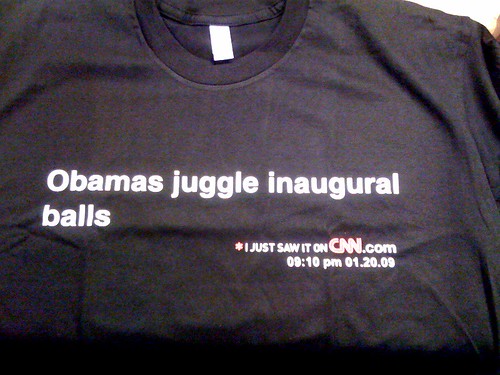
It's too bad CNN doesn't do headlines on t-shirts anymore; then again, I think I made out pretty well before it was all said and done (mine's in red).
It's too bad CNN doesn't do headlines on t-shirts anymore; then again, I think I made out pretty well before it was all said and done (mine's in red).
A Degree In Growing Pot
From CNN:
The CNN reporter is pretty absurd in the coverage, at one point asking the Pot Grower about the development of clean energy for economic growth instead of legalizing pot. Nevertheless the story includes some of the interesting contradictions in Michigan law. You just kind of have to see it for yourself.
The CNN reporter is pretty absurd in the coverage, at one point asking the Pot Grower about the development of clean energy for economic growth instead of legalizing pot. Nevertheless the story includes some of the interesting contradictions in Michigan law. You just kind of have to see it for yourself.
Air Marshalls
CNN has a report this morning on the air marshall program; not surprisingly, there are bureaucratic issues that distort the intentions of the program. To look more productive, marshalls oftentimes ride on shorter regional routes instead of long haul international flights, like this one. One estimate put the price tag at over $200 million per arrest.
Though the FAMS program is secretive of assignments by design, I'd love to get my hands on the air marshalls data and see what comes of it.
Though the FAMS program is secretive of assignments by design, I'd love to get my hands on the air marshalls data and see what comes of it.
Wednesday, February 03, 2010
Free (Baseball) Data
I stumbled across my old data from my first publication, and have posted it online. It contains the signing salaries of MLB Free Agents between 1991 and 2002. It has player stats, signing team characteristics, signing team's city characteristics, and simulated tax burden with an accompanying instrument.
Of course I will be happy if someone extends the work, but it might also be a convenient dataset for students interested in baseball who are also looking to run a regression and write up the results for their econometrics class.
Enjoy!
Of course I will be happy if someone extends the work, but it might also be a convenient dataset for students interested in baseball who are also looking to run a regression and write up the results for their econometrics class.
Enjoy!
The Effect of Prayer on God's Attitude Toward Mankind
That's the title of a paper by James Heckman in the new release of Economic Inquiry. Here's an ungated copy.
From the abstract:
From the abstract:
This paper uses data available from the National Opinion Research Center's (NORC) survey on religious attitudes and powerful statistical methods to evaluate the effect of prayer on the attitude of God toward human beings.From the results:
A little prayer does no good and may make things worse. Much prayer helps a lot.The appendix includes an interesting response from Father Andrew Greeley, a well known Catholic priest and sociologist.
CBA and Bulletproof Clothing
Here is a CNN story on a Colombian tailor who makes his clothing bulletproof, even at point blank range. It opens up an interesting cost-benefit question for a social welfare analyst:
Let's assume that point-blank assassins aim at their targets in a manner that maximizes the probability of death:
Where p(Hit) is a function of size of the area on the target (torso is a higher probability shot than the head, for instance), but p(Death|Hit) shrinks with the size of the area on the target (torso shots are less likely to kill than head shots).
Suppose, pre-bulletproof clothing, the dominant strategy for point-blank assassins is a single shot to the torso. It is observed by the population at risk that there is a stochastic random distribution around the area of the heart and torso. This creates the sufficient demand for bulletproof clothing.
If enough of the target population adopt bulletproof clothing, it seems to me the dominant equilibrium strategy shifts to head-shots, which remain unprotected but are harder to hit. On the net, I think we could expect the number of successful assassinations to decrease, but will it be enough collectively to justify the new more expensive tailoring? Could this be an individually rational but collectively irrational product? Things can get really interesting if you assume different levels of risk aversion among assassins.
Let's assume that point-blank assassins aim at their targets in a manner that maximizes the probability of death:
p(Death) = p(Hit)*p(Death|Hit).
Where p(Hit) is a function of size of the area on the target (torso is a higher probability shot than the head, for instance), but p(Death|Hit) shrinks with the size of the area on the target (torso shots are less likely to kill than head shots).
Suppose, pre-bulletproof clothing, the dominant strategy for point-blank assassins is a single shot to the torso. It is observed by the population at risk that there is a stochastic random distribution around the area of the heart and torso. This creates the sufficient demand for bulletproof clothing.
If enough of the target population adopt bulletproof clothing, it seems to me the dominant equilibrium strategy shifts to head-shots, which remain unprotected but are harder to hit. On the net, I think we could expect the number of successful assassinations to decrease, but will it be enough collectively to justify the new more expensive tailoring? Could this be an individually rational but collectively irrational product? Things can get really interesting if you assume different levels of risk aversion among assassins.
Tuesday, February 02, 2010
Super Bowl Props: Year 3
It's time for this year's Super Bowl prop-a-thon! TPS stalwart Rob Holub sends along this year's props. Here's last year's post and here's the year before. Rob issued me a sound beating last year, so I need a better performance. Feel free to add in your choices and see how you do!
For the uninitiated, props are bets on certain outcomes within the game. Extremely popular games-- like national championships in college sports and title games/series in professional sport-- tend to have some listing of prop bets, though in the vast majority of games you can usually wager only on the winner and an over/under for total points scored. As always, bets are for recreational purposes only.
One final thing-- to avoid the four-corners effect, it makes a little more sense to pick props that are priced at roughly 50% (or below, if you so choose). You don't quite get the same effect from taking the "no" on the two point conversation (paying a meager -600) as you do from taking the over/under jersey number bet (generally priced at the even -115/-115 spread, and an annual Holub lead-pipe lock).
Onwards! Here are my picks:
- Will the game be tied after 0-0? Yes. (+100)
- Total Number of Different Players to Have a Pass Attempt: 2.5 (2-pt conversions do not count). Over. (+240)
- Saints: Will they convert a 4th down attempt? Yes. (+125)
- Robert Meachem, Total Receiving Yards on 1st reception: 10.5. Over. (-115)
- Peyton Manning, Will Have More Passing Yards in Which Half? Second. (-105)
You got nothing on those, Holub! I also like how four of my five prop bets could conceivably be satisfied on one play.
Again, feel free to play along in the comments.
For the uninitiated, props are bets on certain outcomes within the game. Extremely popular games-- like national championships in college sports and title games/series in professional sport-- tend to have some listing of prop bets, though in the vast majority of games you can usually wager only on the winner and an over/under for total points scored. As always, bets are for recreational purposes only.
One final thing-- to avoid the four-corners effect, it makes a little more sense to pick props that are priced at roughly 50% (or below, if you so choose). You don't quite get the same effect from taking the "no" on the two point conversation (paying a meager -600) as you do from taking the over/under jersey number bet (generally priced at the even -115/-115 spread, and an annual Holub lead-pipe lock).
Onwards! Here are my picks:
- Will the game be tied after 0-0? Yes. (+100)
- Total Number of Different Players to Have a Pass Attempt: 2.5 (2-pt conversions do not count). Over. (+240)
- Saints: Will they convert a 4th down attempt? Yes. (+125)
- Robert Meachem, Total Receiving Yards on 1st reception: 10.5. Over. (-115)
- Peyton Manning, Will Have More Passing Yards in Which Half? Second. (-105)
You got nothing on those, Holub! I also like how four of my five prop bets could conceivably be satisfied on one play.
Again, feel free to play along in the comments.
Monday, February 01, 2010
Celebrity Look-alike
Has anyone else noticed how similar Bryan Caplan and William Stanley Jevons look?


Thursday, January 28, 2010
State of the Union: More of the Same
Tad DeHaven at Cato offers a side by side comparison of Obama and Bush II by observing SOTU quotes from each. On balancing the budget, for example:
[HT: Steve @ CP]
“Starting in 2011, we are prepared to freeze government spending for three years. Spending related to our national security, Medicare, Medicaid, and Social Security will not be affected. But all other discretionary government programs will. Like any cash-strapped family, we will work within a budget to invest in what we need and sacrifice what we don’t. And if I have to enforce this discipline by veto, I will.And energy...
We will continue to go through the budget line by line to eliminate programs that we can’t afford and don’t work.”
–Barack Obama, 2010 SOTU
“Just as we trust Americans with their own money, we need to earn their trust by spending their tax dollars wisely. Next week, I’ll send you a budget that terminates or substantially reduces 151 wasteful or bloated programs, totaling more than $18 billion. The budget that I will submit will keep America on track for a surplus in 2012.”
–George W. Bush, 2008 SOTU
“In 2 weeks, I will send you a budget that funds the war, protects the homeland, and meets important domestic needs while limiting the growth in discretionary spending to less than 4 percent. This will require that Congress focus on priorities, cut wasteful spending, and be wise with the people’s money. By doing so, we can cut the deficit in half over the next 5 years.”
–George W. Bush, 2004 SOTU
“My budget substantially reduces or eliminates more than 150 government programs that are not getting results, or duplicate current efforts, or do not fulfill essential priorities. The principle here is clear: a taxpayer dollar must be spent wisely, or not at all.”
–George W. Bush, 2005 SOTU
“But to create more of these clean energy jobs, we need more production, more efficiency, more incentives. That means building a new generation of safe, clean nuclear power plants in this country. It means making tough decisions about opening new offshore areas for oil and gas development. It means continued investment in advanced biofuels and clean coal technologies. And yes, it means passing a comprehensive energy and climate bill with incentives that will finally make clean energy the profitable kind of energy in America.”Jobalism...
–Barack Obama, 2010 SOTU
“Good jobs also depend on reliable and affordable energy. This Congress must act to encourage conservation, promote technology, build infrastructure, and it must act to increase energy production at home so America is less dependent on foreign oil.”
–George W. Bush, 2002 SOTU
“I have sent you a comprehensive energy plan to promote energy efficiency and conservation, to develop cleaner technology, and to produce more energy at home. I have sent you Clear Skies legislation that mandates a 70-percent cut in air pollution from powerplants over the next 15 years.”
–George W. Bush, 2003 SOTU
“I realize that for every success story, there are other stories, of men and women who wake up with the anguish of not knowing where their next paycheck will come from; who send out resumes week after week and hear nothing in response. That is why jobs must be our number one focus in 2010, and that is why I am calling for a new jobs bill tonight.”Looks like Hope and Change went down the drain. And we are left with more of the same. Surprise, surprise.
–Barack Obama, 2010 SOTU
“Americans who have lost their jobs need our help, and I support extending unemployment benefits and direct assistance for health care coverage. Yet, American workers want more than unemployment checks; they want a steady paycheck. When America works, America prospers, so my economic security plan can be summed up in one word: jobs.”
–George W. Bush, 2002 SOTU
[HT: Steve @ CP]
Wednesday, January 27, 2010
Stimulus Signs
I'm enjoying especially the news stories coming out talking about particularly offbeat uses of stimulus funds, if for no other reason than they give nice ammunition for spontaneous discussion about the shortcoming of stimulus spending. That, and let's assume that the media in general feels there are worthy and unworthy uses for stimulus money-- beneficial and unbeneficial. I could take issue with that, but the end effect for me is still good-- the media sends along thing they find ridiculous, I'm always going to think they're ridiculous, so the mechanism works out. As one of the Bobs said: Problem's solved from my end!
Anyhow, here's one from CNN talking about $1 million in stimulus funding used to create signs telling Ohioans where their stimulus money is going. There's a particularly tidy nature to this specific example.
Seen any others? I'll keep 'em coming as I find them.
Anyhow, here's one from CNN talking about $1 million in stimulus funding used to create signs telling Ohioans where their stimulus money is going. There's a particularly tidy nature to this specific example.
Seen any others? I'll keep 'em coming as I find them.
Tuesday, January 26, 2010
Swine Flu Update
TPS friend Pavel Yakovlev sends along this bit concerning the swine flu; my thoughts from April are here, I'm happy to admit that it became a bit more of an issue than I projected if the other side would admit that it became nowhere near the issue they projected it to be. Also, for what it's worth, the elderly didn't end up in the high risk groups due to what the medical folk say was a similar virus a few decades ago that provided enough resistance to the current H1N1 virus.
Note the regulatory control aspects of the story-- government secures contracts with pharmaceutical companies that are activated with the World Health Organization's declaration of "pandemic," and the pharmaceutical companies' role in influencing the determination of which medical scenarios are elevated to "pandemic" status. The appropriate quotes:
Note the regulatory control aspects of the story-- government secures contracts with pharmaceutical companies that are activated with the World Health Organization's declaration of "pandemic," and the pharmaceutical companies' role in influencing the determination of which medical scenarios are elevated to "pandemic" status. The appropriate quotes:
"The aim is that none of the pharmaceutical companies under any circumstances must be allowed to make their influence felt on pandemic emergencies,” he says and adds that rules for patenting also will be checked...
..."The governments have sealed contracts with vaccine producers where they secure orders in advance and take upon themselves almost all the responsibility. In this way the producers of vaccines are sure of enormous gains without having any financial risks. So they just wait, until WHO says "pandemic” and activate the contracts."
For that reason, Wolfgang Wodarg also finds it suspicious that WHO changed it’s definition of a pandemic on it’s homepage at the end of May this year:
"From June 2009 it is no longer necessary, that "an enormous amount of people have contracted the illness or died” - there simply have to be a virus, spreading beyond borders, and one that people have no immunity towards,” he says.
Monday, January 25, 2010
Public v. Private
From the Washington Post:
[HT: Astrid Arca]
Aside from the large banner advertising perpetual rental specials to traffic on U.S. Route 50, the most noticeable thing about the property is its neat, uniform landscaping. Privately owned Kingsley Commons' lush grass, wooden fences, shrubs and flowers stand in contrast to the patchy lawns and exposed dumpsters of the adjacent public housing owned and managed by the Fairfax County Redevelopment and Housing Authority. That property, known as Kingsley Park, appears to have once been part of the same construction as Kingsley Commons, though Kingsley Commons has added some external cosmetic details to its units.As it turns out, I am in the process of moving and have submitted my application for a town house at Kingsley Commons. I had no idea that they specialized in "affordable and subsidized Section 8 housing," as the article indicates. The town houses they offer look great!
[HT: Astrid Arca]
2010 SEA Sessions
Anyone organizing a session on public finance? I'd be interested in contributing an abstract on one of these topics:
My contact info here, if interested.
- State Tax Amnesties
- Local property tax incentives in policy
- Property tax assessment and progressivity
My contact info here, if interested.
Sunday, January 24, 2010
On Lobbying: Remember the Symmetry!
When it comes to lobbying, there is Supply and Demand. Everyone is good at remembering and complaining about supply, but demand is often forgotten. If small groups can be targeted, then politicians have a strong incentive to use that as a weapon to solicit rents. Politicians want lobbying.
Now, from Yahoo News (HT: KipEsquire):
Now, from Yahoo News (HT: KipEsquire):
WASHINGTON – Dozens of current and former corporate executives have a message for Congress: Quit hitting us up for campaign cash.
Roughly 40 executives from companies including Playboy Enterprises, ice cream maker Ben & Jerry's, the Seagram's liquor company, toymaker Hasbro, Delta Airlines and Men's Wearhouse sent a letter to congressional leaders Friday urging them to approve public financing for House and Senate campaigns. They say they are tired of getting fundraising calls from lawmakers — and fear it will only get worse after Thursday's Supreme Court ruling.
Saturday, January 23, 2010
Political Sunk Costs
They're different for different people for different reason, but one of the big light-bulb-above-the-head moments for me in graduate school was the idea that political costs and benefits differ from economic costs and benefits. I don't think I've gone through a paper on an appropriate topic that I haven't taken a good look at the idea from political vs. economic costs and benefits. For me, it's a great tool to get my thinking going in the right direction.
Now, in light of the surprise Republican win in recent Massachusetts election for Kennedy's vacant Senate seat, I'm wondering if the idea of sunk costs differ in the political realm versus the economic realm. I'm paraphrasing, but the gist of what is coming out of Washington is "we've worked this hard on the health care bill, it would be a shame if we didn't do something." Economic rationale would say if the benefits of moving forward outweigh the costs of moving forward, then full steam ahead. If not, then cut the cord-- but either way, it doesn't matter what you've already done.
But it doesn't seem the same in politics. There may or may not be a large political cost of not getting something done-- but now you're factoring in the past into your future decisions. I know of some studies that have shown that people don't tend to act in the homo economicus manner of ignoring sunk costs, but to me, it seems that nothing's sunk when it comes to politics. To that end, cram another wedge between economic and political costs and benefits.
Now, in light of the surprise Republican win in recent Massachusetts election for Kennedy's vacant Senate seat, I'm wondering if the idea of sunk costs differ in the political realm versus the economic realm. I'm paraphrasing, but the gist of what is coming out of Washington is "we've worked this hard on the health care bill, it would be a shame if we didn't do something." Economic rationale would say if the benefits of moving forward outweigh the costs of moving forward, then full steam ahead. If not, then cut the cord-- but either way, it doesn't matter what you've already done.
But it doesn't seem the same in politics. There may or may not be a large political cost of not getting something done-- but now you're factoring in the past into your future decisions. I know of some studies that have shown that people don't tend to act in the homo economicus manner of ignoring sunk costs, but to me, it seems that nothing's sunk when it comes to politics. To that end, cram another wedge between economic and political costs and benefits.
Friday, January 22, 2010
A Tad Too Strong
A JPT article summarizing Mankiw's article on optimal height taxation:
Extreme examples, yes, but these are just things I can observe now, in the absence of a height tax. How would the world change in its presence? Markets in everything, folks.
One correlate of ability is easy to measure and impossible to game: your height.Impossible? I don't know about you, but one of the things I find most exciting about this idea is to find out how people really would respond to this tax. One of friends is currently undergoing therapy because she "hunched" as a child, and therefore should actually be a little taller if her spinal muscles learn to relax. Another friend of mine is dealing with a genetic spinal issue that is causing him to gradually lose height. I doubt either of them would change their final choice to deal with these issues, but would it make it easier to delay treatments?
Extreme examples, yes, but these are just things I can observe now, in the absence of a height tax. How would the world change in its presence? Markets in everything, folks.
MPIs: Seen v. Unseen
Here's another news hit for the TF piece. They managed to pull one of my favorite lines from the article:
“Rather than addressing the underlying problem and encouraging growth and development primarily by reducing tax burdens across the board and removing cumbersome regulations, which is politically challenging, politicians focus on what’s easy: industry specific incentives,” said Tax Foundation Adjunct Scholar William Luther, the author of the study “Movie Production Incentives: Blockbuster Support for Lackluster Policy.”Unfortunately, the punchline is being overlooked by legislators who cannot seem to get past the seen/unseen problem.
“I would argue that 100 percent of nothing is still nothing if they’re not coming here,” [State Senator] Haridopolos said. “The money they spend here helps our restaurants, hotels, our tourists attractions. I think it’s a good deal and the only way you get paid is after the work is completed.”What's the problem? I mean... it is good for the glazier!
Thursday, January 21, 2010
Movie Production Incentives in the News
It looks like my Tax Foundation report on Movie Production Incentives is getting some press. Here's an article from the Las Vegas Review-Journal. Here's another from the Boston Business Journal.
Wednesday, January 20, 2010
The Passions and the Interests
If you are teaching an Honors section of Econ 101 at a liberal arts college, let me recommend the following book: The Passions and the Interests by A.O. Hirschman. I am roughly halfway through and find it very interesting. You might think of it as a crash course in the history of ideas from Augustine to Smith. The evolution of basic concepts in economics (self-interest, rationality, spontaneous order, etc) as presented by Hirschman is fascinating.
The Lincoln Quote Quandary
I've always been interested in verifying a shadowy Abraham Lincoln quote concerning the detriments of foreign trade. I mentioned it at the end of this blog post about 18 months ago; my curiosity predates that post by at least another few years.
Well, the mystery has been solved...sort of. I put the issue to my International class this semester and John Pulito found a paper discussing that exact quote-- in the QJE, by F.W. Taussig in 1914.
The quote at question is the following:
Interestingly, the article is actually about how Lincoln likely never actually said it. Parsing through his notes from 1847-1867 there are some intimations that he believed the general premise of the above quote, and mentioned something similar at a speech in Pittsburgh in 1861, but in no recorded place can anyone attribute the exact quote to Lincoln. As best as I can tell, no one has taken up the issue again.
So my conclusion is this: If presented with this quote, Lincoln would have agreed, but he seems to have never spoken those exact words.
Well, the mystery has been solved...sort of. I put the issue to my International class this semester and John Pulito found a paper discussing that exact quote-- in the QJE, by F.W. Taussig in 1914.
The quote at question is the following:
"I do not know much about the tariff, but I know this much, when we buy manufactured goods abroad, we get the goods and the foreigner gets the money. When we buy manufactured goods at home, we get both the goods and the money."
Interestingly, the article is actually about how Lincoln likely never actually said it. Parsing through his notes from 1847-1867 there are some intimations that he believed the general premise of the above quote, and mentioned something similar at a speech in Pittsburgh in 1861, but in no recorded place can anyone attribute the exact quote to Lincoln. As best as I can tell, no one has taken up the issue again.
So my conclusion is this: If presented with this quote, Lincoln would have agreed, but he seems to have never spoken those exact words.
Tuesday, January 19, 2010
Haiti thoughts
Tyler's been doing a good job talking about Haiti over the past week; I think today's efforts are his most intriguing yet. Squatters rights is interesting idea; is it beyond the task of defining property rights in general? Further, if dropping trade restrictions against countries qualifies as humanitarian assistance, do developed countries use trade barriers as banked chips in case they need to act in the future?
I'd love to see what Emily has to say given this situaion is a natural disaster, what Claudia and Dave have to say given the aid being directed towards Haiti (humanitarian now, development likely later), what Pete Leeson has to say given we've got a Somalia-type scenario in Haiti at the moment, and what Chris Coyne has to say given the U.S. government's seemingly inevitable role in rebuilding this country.
There are going to be a lot of government-free outcomes to analyze in the upcoming weeks and months; keep your internet-eyes honed!
I'd love to see what Emily has to say given this situaion is a natural disaster, what Claudia and Dave have to say given the aid being directed towards Haiti (humanitarian now, development likely later), what Pete Leeson has to say given we've got a Somalia-type scenario in Haiti at the moment, and what Chris Coyne has to say given the U.S. government's seemingly inevitable role in rebuilding this country.
There are going to be a lot of government-free outcomes to analyze in the upcoming weeks and months; keep your internet-eyes honed!
Capturing Poor Driving
The following was put to me recently: How would you go about researching which areas/cities have the worst drivers?
Here's my take, note that I'm not really answering the question, and I'm sure Justin can improve upon it in half the words in the comment section:
1. It's tough to capture bad driving because many things that we consider to constitute "bad driving" aren't captured in any sort of statistics. I've yet to see the state-by-state time series of "number of instances of cutting someone off."
2. Surveys wouldn't work; I'd expect a similar result to 70%-of-people-consider-themselves-better-than-average-drivers. People systematically underestimate the quality of drivers around them. I am Exhibit 1A for that one.
3. Bad driving outcomes could very well be a function of mixing different types of drivers. Let's assume we've got two types of drivers, aggressive and passive. A city with nothing but aggressive drivers may well have more reported accidents than a city with nothing but passive drivers, but a city with a mix of the two may have the most of all. To that end, quantifying the quality of driver is only useful insofar that you can define the relationship between a spectrum of drivers operating within a driving environment.
4. With regards to age, I will say that more younger drivers (read: first few years of driving) make for more dangerous driving situations, if only because experience matters. It's unclear to me at this point how the upper end of the age spectrum looks.
What else is there?
Here's a post from the summer on courteous driving.
Here's my take, note that I'm not really answering the question, and I'm sure Justin can improve upon it in half the words in the comment section:
1. It's tough to capture bad driving because many things that we consider to constitute "bad driving" aren't captured in any sort of statistics. I've yet to see the state-by-state time series of "number of instances of cutting someone off."
2. Surveys wouldn't work; I'd expect a similar result to 70%-of-people-consider-themselves-better-than-average-drivers. People systematically underestimate the quality of drivers around them. I am Exhibit 1A for that one.
3. Bad driving outcomes could very well be a function of mixing different types of drivers. Let's assume we've got two types of drivers, aggressive and passive. A city with nothing but aggressive drivers may well have more reported accidents than a city with nothing but passive drivers, but a city with a mix of the two may have the most of all. To that end, quantifying the quality of driver is only useful insofar that you can define the relationship between a spectrum of drivers operating within a driving environment.
4. With regards to age, I will say that more younger drivers (read: first few years of driving) make for more dangerous driving situations, if only because experience matters. It's unclear to me at this point how the upper end of the age spectrum looks.
What else is there?
Here's a post from the summer on courteous driving.
Monday, January 18, 2010
No Solutions, Only Trade-Offs
"The Intended and Unintended Effects of Youth Bicycle Helmet Laws," from the NBER:
These percentages look somewhat lopsided, but you have to consider the magnitudes of the levels of the variables. I can't find the average number of youth fatalities by state in the above paper, but inferring from the NHTSA, there were about 105 total youth fatalities in the entire United States. So in total, we are probably talking about saving lives by the tens or twenties.
On the other hand, the volume of participation is probably quite large. In the paper above, participation was 84 percent of a 115,000 person sample. A 4-5 percent reduction for the population at large is probably in the hundreds of thousands. To some extent, these participation reductions likely account for some of the reduced fatalities being reported.
The question becomes: How many forgone participants equal a life saved, knowing that the only 100% safe bicycling is no bicycling at all?
Over 20 states have adopted laws requiring youths to wear a helmet when riding a bicycle. We confirm previous research indicating that these laws reduced fatalities and increased helmet use, but we also show that the laws significantly reduced youth bicycling. We find this result in standard two-way fixed effects models of parental reports of youth bicycling, as well as in triple difference models of self-reported bicycling among high school youths that explicitly account for bicycling by youths just above the helmet law age threshold. Our results highlight important intended and unintended consequences of a well-intentioned public policy.The estimates indicate that bicycling fatalities among youth (age 0-15) decreased across states by about 19 percent. It also decreased youth bicycling participation by 4 to 5 percent.
These percentages look somewhat lopsided, but you have to consider the magnitudes of the levels of the variables. I can't find the average number of youth fatalities by state in the above paper, but inferring from the NHTSA, there were about 105 total youth fatalities in the entire United States. So in total, we are probably talking about saving lives by the tens or twenties.
On the other hand, the volume of participation is probably quite large. In the paper above, participation was 84 percent of a 115,000 person sample. A 4-5 percent reduction for the population at large is probably in the hundreds of thousands. To some extent, these participation reductions likely account for some of the reduced fatalities being reported.
The question becomes: How many forgone participants equal a life saved, knowing that the only 100% safe bicycling is no bicycling at all?
Friday, January 15, 2010
The Crisis of Credit Visualized
I ran across this neat presentation on the Credit Crisis. As a fan of presentations that communicate a lot of information in a clear manner, I think this is quite good. I'll leave it, however, to the intelligent readers of TPS to explain where the presentation gets it right and goes awry.
HT: Duarte BlogWorking Paper: Monetary Anarchy
Here's the abstract from my latest working paper:
Many economists, from Adam Smith to Nobel Laureate James M. Buchanan, have argued that free-markets only function correctly within an institutional framework that stipulates property rights, enforces contracts, and provides a medium of exchange. Furthermore, it is assumed that markets are incapable of generating this framework without the assistance of government. Specifically, Buchanan (2009) claims markets are incapable of producing a stable paper currency standard. If left to the market, Buchanan and others predict, the monetary regime will be highly inflationary. In contrast, I argue that monetary anarchy is a feasible alternative; decentralized agents acting in their own self-interest are capable of generating a stable paper currency standard. A counterfeit commodity standard—where any individual can print as many paper notes as desired without obligation to redeem these notes for some commodity—has all the self-adjusting properties of traditional commodity standards (e.g gold standard). Additionally, it has the potential to adjust more quickly to short-run fluctuations and use fewer resources than traditional commodity standards. Most importantly, the success of this standard relies only on underlying fundamentals and not the precommitments of men who might later renege. I detail the mechanics of a counterfeit commodity standard and illustrate feasibility by analyzing the quasi-counterfeit commodity standard implemented in Somalia.An updated draft will be posted soon.
Movie Production Incentives
A couple summers ago I spent some time at the Tax Foundation as a policy intern. It was a great experience and I recommend the Tax Foundation to others seeking policy experience in DC. They are a highly respected organization. Additionally, they were very flexible (and appreciative) with respect to the research I conducted.
Yesterday, they released my Special Report on Movie Production Incentives. Here are the key findings:
Yesterday, they released my Special Report on Movie Production Incentives. Here are the key findings:
• Forty-four states now offer significant movie production incentives (MPIs), up from five states in 2002, and twenty-eight states offer film tax credits.
• In the face of state budget pressures and preposterously generous incentives in Louisiana and Michigan, states may curtail or even terminate their MPI programs. Kansas and Iowa have suspended theirs, Kansas for two years to save revenue and Iowa briefly to investigate corruption.
• MPIs have often escaped routine oversight about benefits, costs and activities.
• Spurious research is common in campaigns for film tax credits, often featuring dramatic job creation claims. A recent study concluded that Pennsylvania's film tax credit produces net benefits of $4.5 million by assuming that any business interacting with the film industry would not exist but for the credit. MPIs create mostly temporary positions with limited options for upward mobility.
• The MPI experience demonstrates that a politically connected industry can grow if the state greatly reduces its taxes, but states should have a tax system that operates as a welcome mat to all industries, not just those politicians have picked.
Wednesday, January 13, 2010
On Time Arrivals to Class
I've noticed something very interesting here at Duquesne since I started: The students are rarely, if ever, late for class. Why is that?
It's fair to note that my frame of reference is my time spent teaching at WVU, but I think it's unfair to categorize Duquesne students as that much more concerned in showing up to class on time. Similarly, I don't think the incidence of off-campus commuters plays a large role in explaining the difference-- I've had plenty of students at both schools drive in to attend class.
I think it has to do with the fact that most students take elevators to get to class. Elevators introduce a degree of uncertainty into the class arrival time function; most people know how long it takes to walk somewhere, but taking the elevator increases the variance in expected arrival time. I would guess that many students aren't terribly averse to arriving a minute or two late to class; however, these same students may be particularly averse-- in relative terms, if nothing else-- to arriving a few minutes later, say, 4-6 minutes. A sufficiently high enough level of uncertainty in the elevators could push students to arrive early enough to ensure that they never hit this 4-6 minute late arrival.
Then again, there's no reason to believe they couldn't update their beliefs on the elevator through experience. But I think that assuming elevators will be continually uncertain is getting kids into my classes on time.
There's a perfect natural experiment for this, of course-- teach (or witness) a class in another building. Until that time comes, I'm sticking with the elevator story.
It's fair to note that my frame of reference is my time spent teaching at WVU, but I think it's unfair to categorize Duquesne students as that much more concerned in showing up to class on time. Similarly, I don't think the incidence of off-campus commuters plays a large role in explaining the difference-- I've had plenty of students at both schools drive in to attend class.
I think it has to do with the fact that most students take elevators to get to class. Elevators introduce a degree of uncertainty into the class arrival time function; most people know how long it takes to walk somewhere, but taking the elevator increases the variance in expected arrival time. I would guess that many students aren't terribly averse to arriving a minute or two late to class; however, these same students may be particularly averse-- in relative terms, if nothing else-- to arriving a few minutes later, say, 4-6 minutes. A sufficiently high enough level of uncertainty in the elevators could push students to arrive early enough to ensure that they never hit this 4-6 minute late arrival.
Then again, there's no reason to believe they couldn't update their beliefs on the elevator through experience. But I think that assuming elevators will be continually uncertain is getting kids into my classes on time.
There's a perfect natural experiment for this, of course-- teach (or witness) a class in another building. Until that time comes, I'm sticking with the elevator story.
Tuesday, January 12, 2010
Swinger Economics II
I blogged about this before, based on conversation with a friend in the know. Now forthcoming at the Journal of Socio-Economics is the "Economics of Swinging" by Fabio D'Orlando. Abstract:
Swinging is a sexual behavior of increasing relevance but substantially ignored in theoretical economic investigation. This paper has two major goals. The first is to describe what swinging is, discuss its economic relevance and single out the main characteristics of swinger behavior. To this end, the Italian situation has been considered as a type of case study. The second goal is to use standard and less-standard tools from economic theory to propose some preliminary assessments of the causes and consequences of swinger couples’ behavior. In this respect, some contributions on two-sided markets, hedonic adaptation approaches and equilibrium matching models have proved particularly useful.Here is an ungated version. I was so convinced that this was a pen name that I googled the author's name, and came across another paper of his on the pornography market, complete with empirical data.
Sunday, January 10, 2010
Zoning: Regulation, Community Property Right, or Both?
Frank Stephenson at D.O.L. remarks on Levine's Zoned Out:
I do have one quibble--the author can't quite make up his mind what we economists think of zoning:
p. 80: "[T]he very meaning of zoning as a collective property right--a view now broadly adopted by the economics profession ..."
p. 87: "Economists and other social scientists have split on the nature of zoning--with some viewing it as governmental regulation and others viewing it as more akin to a 'collective property right.'"
I have not read the book in question, but I actually would agree that the economics profession is of two minds about zoning: one as regulation and one as a collective property right (CPR). I think your modal economist would see it as regulation, but your modal economist researching and publishing on local public finance or governance structures are more likely to view it as a CPR. Richard Epstein would be an obvious candidate for disagreement.
I'm going to provide some explanation of the CPR view.
On paper, zoning is indeed regulation, having very specific prescriptions with ambiguous intentions. In function, what they are trying to do is protect home owners from negative externalities, both pecuniary and technological. Since all technological externalities (noise, traffic, etc) are capitalized into housing prices in the same way as if a bunch of new housing were constructed in the area, home owners and zoning officials have little reason to differentiate between them.
At the same time, it is extremely difficult to get around the fact that externalities are a big deal, and any nuisance is not just annoying, it is costly. Furthermore, in a world without zoning, new housing can be constructed quickly if demand is expected to rise. If demand falls construction will stop, but the housing stock is not likely to change a great deal (in part because of demolition costs). This makes externality-sensitive housing a rather asymmetric risk. If demand rises in your area, housing will only appreciate at the marginal cost of construction, but if demand falls your price falls steeply.
Furthermore, your neighbors have a pretty good incentive to ignore externalities when they sell their homes. If your neighbor sells their home to someone who wants to renovate the property into a noisy bar, he doesn't have much incentive to consider how this might impact his ex-neighbors. Note that, although the noise is a technological externality, it will have a negative pecuniary effect on the neighboring homes.
Enter the role of zoning. The CPR view begins by thinking of a given municipality as a supplier of institutions and property. The institutions are going to consist of a mix of taxes, public goods, and mechanisms for handling externalities (i.e. zoning). Developers or other commercial producers are on the demand side of this market. They are likely to bring benefits (tax revenue, local demand for property, etc) to an area, as well as new pecuniary and non-pecuniary externalities (congestion, pollution, new supply of alternative residences, etc).
Zoning serves as an exclusionary purpose (like a property right) to these entities, but remains open to change pending some negotiation. In fact, zoning is probably the most malleable legal institution in the United States. While the stated objective of zoning commissions is often ambiguous, in practice they serve the purpose of evaluating demanders of institutions/property to verify that their expected benefits outweigh their costs, which will be signaled through their expected consequence on existing property values.
I don't mean to say zoning is all roses and fine wine, the critics of zoning have good points. Zoning commissions make both type I and type II errors, inflate housing prices, can get captured, engage in regulatory taking, etc. Any industry with more than 30,000 firms would likely have more than a few bad apples.
I think the community property rights view is quite correct in the positive analysis of zoning, but the open question is the normative implication. As of now, I lean towards a more Ostromesque view that zoning is a way that local communities have evolved to deal with externalities, and I would be very hesitant to impose some kind of reform that stripped them of this mechanism.
Saturday, January 09, 2010
Thursday, January 07, 2010
Mackey in the New Yorker
Here's an interesting bit about Whole Foods CEO John Mackey. It's long, as New Yorker pieces tend to be, but it's an interesting read (also a typical quality of the New Yorker). I have to admit, Mackey's one of the more unique people out there. I think this line hits the scenario perfectly:
He also was on Stossel's new show talking about health care.
The right-wing hippie is a rare bird, and it’s fair to say that most of Whole Foods’ shoppers have trouble conceiving of it.
He also was on Stossel's new show talking about health care.
Monday, January 04, 2010
Worst. Decade. Ever.
The Zero's? The noughties? The pre-teens? I don't know what to call it. But ReasonTV calls it the worst decade ever.
[HT: Art @ DOL]
[HT: Art @ DOL]
Saturday, January 02, 2010
New Year, New Laws
Welcome to 2010! We're heading into Year 5 of good times here at TPS.
Anyhow, CNN gives an overview of new laws for the new year here, and I've seen a surprising number of TV and print stories concerning this same topic, maybe I wasn't quite in tune to the matter last year at this time. (Hi Dave!)
Perhaps I'm getting more cynical as the months go by, but I'm increasingly frustrated by the passive nature of laws like this. Yes, they're ridiculous, but passive foolishness seems even worse. San Francisco banned plastic shopping bags a little while back-- wouldn't it better just to ban trash? Doesn't that get at the issue a little more directly? One of the new laws in the CNN bit was to ban texting while driving-- why not ban car accidents?
The point being: If we're going to have foolish laws, wouldn't it be better to have clear, direct foolish laws? After all, if you feel that banning texting while driving will actually stop people from texting while driving, then banning car accidents would eliminate those too! You wouldn't even need seat belts! Or car insurance! Or car seats! Oh, the welfare increases!
Is passive lawmaking a way for politicians to dodge the issue of the credibility of the law? I mean, if you're in favor of banning texting while driving, then you are of the opinion that car accidents are bad; wouldn't you necessarily be in favor of banning car accidents as well?
Anyhow, CNN gives an overview of new laws for the new year here, and I've seen a surprising number of TV and print stories concerning this same topic, maybe I wasn't quite in tune to the matter last year at this time. (Hi Dave!)
Perhaps I'm getting more cynical as the months go by, but I'm increasingly frustrated by the passive nature of laws like this. Yes, they're ridiculous, but passive foolishness seems even worse. San Francisco banned plastic shopping bags a little while back-- wouldn't it better just to ban trash? Doesn't that get at the issue a little more directly? One of the new laws in the CNN bit was to ban texting while driving-- why not ban car accidents?
The point being: If we're going to have foolish laws, wouldn't it be better to have clear, direct foolish laws? After all, if you feel that banning texting while driving will actually stop people from texting while driving, then banning car accidents would eliminate those too! You wouldn't even need seat belts! Or car insurance! Or car seats! Oh, the welfare increases!
Is passive lawmaking a way for politicians to dodge the issue of the credibility of the law? I mean, if you're in favor of banning texting while driving, then you are of the opinion that car accidents are bad; wouldn't you necessarily be in favor of banning car accidents as well?
Wednesday, December 23, 2009
Blockquote X
X = Ron Coase:
It is a striking – and for that matter depressing – feature of economics that it has such a static character. It is still the subject that Adam Smith created. It has the same shape, the same set of problems. Now of course we’ve made improvements, we’ve corrected some errors, we’ve tightened the argument, but one could still give a course based on Adam Smith. In some respects it would be better; in some respects it would be worse. But we could base what we say on Adam Smith.
It is a striking – and for that matter depressing – feature of economics that it has such a static character. It is still the subject that Adam Smith created. It has the same shape, the same set of problems. Now of course we’ve made improvements, we’ve corrected some errors, we’ve tightened the argument, but one could still give a course based on Adam Smith. In some respects it would be better; in some respects it would be worse. But we could base what we say on Adam Smith.
Tuesday, December 22, 2009
Stealing as Charity: The Distributional Analysis is Interesting but Incorrect
From CNN:
Tim Jones, parish priest of St Lawrence and St Hilda, told his congregation in York, northern England: "My advice, as a Christian priest, is to shoplift."
[...]He continued: "I do not offer such advice because I think that stealing is a good thing, or because I think it is harmless, for it is neither.
"I would ask that they do not steal from small family businesses, but from large national businesses, knowing that the costs are ultimately passed on to the rest of us in the form of higher prices."
If you read the entire argument in context, the shoplifting aspect is not very interesting or even relevant. People who have exhausted all other means might have to resort to stealing if it means survival, and they don't need a priest to tell them that. What is interesting is his distinction between large and small businesses and how "we" pay the social costs.
In essence, his argument is that an individual in a democratic society which has not elected for "enough" benefits should, when at the point of deciding to steal, impose those costs in dispersed form back onto that society rather than concentrating them on any particular individual. That is a really creative argument, but it leaves something to be desired. (It's also an "eye-for-an-eye" argument, which is a bit strange coming from a priest.)
That which is to be desired is the misplaced view that it is a free lunch for society when a small family business fails due to shoplifting. Competition is competition, no matter how large. There is no reason, ex-ante, to think that smaller businesses failing due to shoplifting would have a smaller impact on market prices than large businesses incurring higher costs that are passed on to consumers. Both cases disperse costs far and wide, and perhaps a few individuals will incur a disproportionate share.
Congrats to Michael Cox!!
For successfully defending his dissertation, titled "Exploring the Dynamics of Social-Ecological Systems: The Case of the Taos Valley Acequias." My favorite paragraph was the one that, in my view, was very representative of the Bloomington School's influence:
Michael is one of our Public Affairs PhD students out of the Workshop on Political Theory and Policy Analysis.
Here is a sample of his work that has a R&R at JEEM. Another chapter of his dissertation has an R&R elsewhere.
Here you can read Elinor Ostrom discuss Michael's scholarly contributions in the context of the Bloomington School in a piece for the Lincoln Land Institute.
He is on the job market this year, so if you are hunting for a candidate please take a look at him. His dissertation committee consisted of Elinor Ostrom (chair), JC Randolph, William Bloomquist, Tom Evans, and myself.
An additional source of disturbance has been the implementation of state-level policies mandating that the New Mexico Office of the State Engineer (OSE) quantify all water rights and regulate them in accordance with the principle of prior appropriation; a principle which, while underlying the acequias’ claims to their historically used water, may also undermine their common property institutional arrangements. This mandate has been implemented in Taos through a formal water rights adjudication suite referred to commonly as the Abeyta case (State of New Mexico ex rel. State Engineer v. Abeyta and State of New Mexico ex rel. State Engineer v. Arellano), the purpose of which is to quantify and prioritize all of the individual-level water rights in the valley.
Michael is one of our Public Affairs PhD students out of the Workshop on Political Theory and Policy Analysis.
Here is a sample of his work that has a R&R at JEEM. Another chapter of his dissertation has an R&R elsewhere.
Here you can read Elinor Ostrom discuss Michael's scholarly contributions in the context of the Bloomington School in a piece for the Lincoln Land Institute.
He is on the job market this year, so if you are hunting for a candidate please take a look at him. His dissertation committee consisted of Elinor Ostrom (chair), JC Randolph, William Bloomquist, Tom Evans, and myself.
Monday, December 21, 2009
Centralized Planning is a Plan for Failure
Chris Coyne passes along this gem which colorfully illustrates "the plan" for Afghanistan.
Does Corporate Tax Incidence Increase Progressivity?
Yes, according to a new working paper out of the Tax Policy Center by Benjamin Harris:
This paper reaches three related conclusions. First, because wage and capital income are highly correlated, higher-income taxpayers will pay a relatively larger share of the tax, regardless of whether the corporate income tax falls on labor or capital. Second, even if capital income is broadly defined to include income accrued to tax-preferred retirement accounts, this conclusion is little-changed. Third, the incidence of the corporate tax has only a modest effect on overall progressivity simply because the tax collects only a small fraction of federal revenues.
The paper uses the Tax Policy Center microsimulation model to estimate the progressivity of the corporate tax—and the tax code in general—under the alternative assumptions that capital bears 20 percent, 50 percent, or 80 percent of the corporate tax burden. Under all three assumptions, average corporate tax rates generally rise with income, indicating progressivity.
Saturday, December 19, 2009
2009 Gus Rankings: Bowl Edition
As there was only one game last weekend between FBS schools, here are the final Gus Rankings for the regular season. I neglected to put the numbers next to the schools noting their actual rank, but here are the previous week's rankings that should be reflective of this week's rankings.
One big advantage of the Gus Rankings would seem to be its ability to compare teams across conferences. If there only were a natural experiment to test this...oh wait, the NCAA offers 35 games that match teams from different conferences. Let's see how Gus does!
(Justin talked about college bowl games here , and here is a similar experiment I did two years ago.)
The typical format for picking bowl games seems to be to assign a point value to each game and see how many points you can accumulate. You are to give every game a point value between 1 and 35, and you can only use each value once. Naturally, the games you feel most strongly about you will give the most points. The key, of course, is to define "feel most strongly about."
We'll do it as follows. Each team has a point total for the season; the team with the most points in the bowl matchup will be predicted as the winner, and the difference in points will determine the confidence in the game.
So, for which bowl game is Gus most confident? That would be the Chick-fil-A Bowl, with Virginia Tech (42 points) lining up against Tennessee (12). Gus also feel pretty confident about the Gator Bowl, with West Virginia (32) facing Florida State (4).
Least confident? Gus is opinion-free concerning the Holiday Bowl, that has Arizona (28) squaring off against Nebraska (28), and isn't terribly confident about the BCS Championship Game, Alabama (75) and Texas (74), the Texas Bowl, Missouri (18) and Navy (17), and the Champs Sports Bowl, Miami (FL) (33) and Wisconsin (32). We'll use the wisdom of the crowd to break any ties-- 76% of the CBS Sportsline crowd likes Nebraska, so we'll go with them, and we'll follow the same methodology to assign confidence levels for bowls that have the same difference in points.
The first game is this afternoon so you'll need to act quickly, but feel free to pit your strategy against the all-knowing, simple-calculating power that is the Gus Rankings.
One big advantage of the Gus Rankings would seem to be its ability to compare teams across conferences. If there only were a natural experiment to test this...oh wait, the NCAA offers 35 games that match teams from different conferences. Let's see how Gus does!
(Justin talked about college bowl games here , and here is a similar experiment I did two years ago.)
The typical format for picking bowl games seems to be to assign a point value to each game and see how many points you can accumulate. You are to give every game a point value between 1 and 35, and you can only use each value once. Naturally, the games you feel most strongly about you will give the most points. The key, of course, is to define "feel most strongly about."
We'll do it as follows. Each team has a point total for the season; the team with the most points in the bowl matchup will be predicted as the winner, and the difference in points will determine the confidence in the game.
So, for which bowl game is Gus most confident? That would be the Chick-fil-A Bowl, with Virginia Tech (42 points) lining up against Tennessee (12). Gus also feel pretty confident about the Gator Bowl, with West Virginia (32) facing Florida State (4).
Least confident? Gus is opinion-free concerning the Holiday Bowl, that has Arizona (28) squaring off against Nebraska (28), and isn't terribly confident about the BCS Championship Game, Alabama (75) and Texas (74), the Texas Bowl, Missouri (18) and Navy (17), and the Champs Sports Bowl, Miami (FL) (33) and Wisconsin (32). We'll use the wisdom of the crowd to break any ties-- 76% of the CBS Sportsline crowd likes Nebraska, so we'll go with them, and we'll follow the same methodology to assign confidence levels for bowls that have the same difference in points.
The first game is this afternoon so you'll need to act quickly, but feel free to pit your strategy against the all-knowing, simple-calculating power that is the Gus Rankings.
Friday, December 18, 2009
Will New Regulations Hurt Non-Profits?
From Reason:
Charged with regulating "financial advice" of all kinds, the massive mandate of the CFPA includes "educational courses," such as the financial literacy program offered by the Girl Scouts, where girls earn badges for learning how money works.Assuming you think 1,279 pages [PDF] of new regulations on financial institutions are a good idea, Rep. Barney Frank (D-Mass), chairman of the House Financial Services Committee, and his coauthors had no choice but to include nonprofits in the mix. A loophole for all nonprofits begs today's for-profit financial advisers to become tomorrow's nonprofit financial advisers—who just happen to have close ties to a bank. Money has a way of flowing around rules (remember campaign finance reform?) so the bill's authors couldn't let nonprofits off the hook.
But there's another dynamic at work as well. In addition to going soft on drugs, crime, and their wives, congressmen now have to worry about appearing to go soft on nonprofits, thanks to the political and financial mess created by the nonprofit ACORN earlier this year.
I would like to add that my belief has increased since this post that the tax treatment of non-profit status is excessively burdensome for non-profits. For a non-profit group to maintain their tax exempt status, there are a variety of fund raising activities they cannot engage in. For example, a museum must be very careful in their management of any gift shops or cafeterias that they might use for a source of funding. It is quite easy for such an operation to wind up violating their tax exempt status, and many avoid doing so for that reason.
Exempting non-profits from taxation is just another part of the charade that corporations and businesses pay taxes they are levied. They suffer the burden of taxation, yes, but that is quite independent of the manner in which they deal with the IRS. Drop the charade and with it the taxation of business income. Then we can get a better look at what non-profits can accomplish.
A Curious Take on College Education
I can't match Will's economics rap songs (or his developing the phrase "Juicing the Mitchell"-- Will's had a solid first year here at TPS), but I do send along this bit on Pell Grants. Note that the author would certainly fall into the skill accumulation camp, not the signaling camp, for a college education. It's an interesting, if ill-reasoned, take on college education as a whole. My thoughts:
1. The author is skeptical about the ability to determine which colleges are doing well While I agree that it's not exact, I think the situation is nowhere near as dire as the author makes it out to be. Even if it's broad, US News & World Report gives a one-stop picture of colleges and provides a rudimentary metric by which to compare them to each other.
2. The author attributes the inability to track good outcomes with the staggering rise in the price of a college education. I don't see the link. Though I've seen research that attributes over half the rise in the price of a college education to forcing colleges to follow a multitude of regulations.
3. Reputation effects are huge for colleges with regards to which graduates do well and where employers will look in the future based on those previous graduates.
4. Assume colleges were strictly skill accumulation academies. If that's the case, there's a massive information opportunity to provide that information in a condensed, easy to access form. Last I checked, there were a lot of people buying a lot of rankings just like these. See #1.
5. It's puzzling to me why choosing a college based on reputation is bad. I suppose it's because I realize that there's a large signaling process in earning a college degree from a reputable school. Though the author even says "reputations are based on...admissions selectivity..." I mean, sweet crispy Christ, he's right there and still can't see it.
6. In the eyes of the author, the value of college is a function of its ability to teach students. Research is excluded, and even the possibility of teaching being a function of research is ignored.
7. In the broad sense, the intimate that students (and parents) are making information-blind decisions concerning one of the most important choices in their life is a bit juvenile.
This article reaffirms the proposition that anything with "Democracy" in the title-- organization, publication, etc.-- is likely to be heading in the wrong direction.
1. The author is skeptical about the ability to determine which colleges are doing well While I agree that it's not exact, I think the situation is nowhere near as dire as the author makes it out to be. Even if it's broad, US News & World Report gives a one-stop picture of colleges and provides a rudimentary metric by which to compare them to each other.
2. The author attributes the inability to track good outcomes with the staggering rise in the price of a college education. I don't see the link. Though I've seen research that attributes over half the rise in the price of a college education to forcing colleges to follow a multitude of regulations.
3. Reputation effects are huge for colleges with regards to which graduates do well and where employers will look in the future based on those previous graduates.
4. Assume colleges were strictly skill accumulation academies. If that's the case, there's a massive information opportunity to provide that information in a condensed, easy to access form. Last I checked, there were a lot of people buying a lot of rankings just like these. See #1.
5. It's puzzling to me why choosing a college based on reputation is bad. I suppose it's because I realize that there's a large signaling process in earning a college degree from a reputable school. Though the author even says "reputations are based on...admissions selectivity..." I mean, sweet crispy Christ, he's right there and still can't see it.
6. In the eyes of the author, the value of college is a function of its ability to teach students. Research is excluded, and even the possibility of teaching being a function of research is ignored.
7. In the broad sense, the intimate that students (and parents) are making information-blind decisions concerning one of the most important choices in their life is a bit juvenile.
This article reaffirms the proposition that anything with "Democracy" in the title-- organization, publication, etc.-- is likely to be heading in the wrong direction.
Keynes vs. Hayek (Word to your mother.)
In what is arguably the most even representation of two viewpoints in the entire history of news reporting, Russ Roberts debates Lord Skidelsky on the merit of adopting Keynesian policy at present. The video also features the Keynes vs. Hayek rap song Roberts wrote (I'll go ahead and apologies for my ridiculous title).
If anyone spots the full version of the rap video, I'd greatly appreciate an email. It does not appear to be available at present.
If anyone spots the full version of the rap video, I'd greatly appreciate an email. It does not appear to be available at present.
Thursday, December 17, 2009
Growth is Good for the Holidays
Christmas will no doubt be a little tough for some families this year. ReasonTV reminds us that it will on large part be better than Christmas in the 1970s, thanks to the wonders of economic growth.
Wednesday, December 16, 2009
The Chinese Government vs the E-Bike
According to this Yahoo! video news report (Hat Tip: Jason Oberle), the Chinese government has resurrected regulations that are 10 years out of date to push consumers away from e-bikes. The e-bikes are produced by the private sector, and critics say this is a move to protect their state-owned competitors.
The story also makes an interesting point that many of the e-bike consumers were looking to switch away from cars, so there may be an environmental consequence as well.
The story also makes an interesting point that many of the e-bike consumers were looking to switch away from cars, so there may be an environmental consequence as well.
Tuesday, December 15, 2009
Blockquoting X
X = Paul Samuelson:
[HT: David Henderson @ Econlog]
[...] there is no sight in the world more awful than that of an old-time economist, foam-flecked at the mouth and hell-bent to cure inflation by monetary discipline. God willing, we shan't soon see his like again.And, in honor of Samuelson, today's edition of Blockquoting X will be a double feature. This one comes from the 1970 edition of his textbook:
"What good does it do a black youth to know that an employer must pay him $2.00 an hour if the fact that he must be paid that amount is what keeps him from getting a job?"
[HT: David Henderson @ Econlog]
Monday, December 14, 2009
Structural vs Atheoretical Econometrics
Forthcoming in the Journal of Econometrics, by Michael Keane:
In this paper I attempt to lay out the sources of conflict between the so-called “structural” and “experimentalist” camps in econometrics. Critics of the structural approach often assert that it produces results that rely on too many assumptions to be credible, and that the experimentalist approach provides an alternative that relies on fewer assumptions. Here, I argue that this is a false dichotomy. All econometric work relies heavily on a priori assumptions. The main difference between structural and experimental (or “atheoretic”) approaches is not in the number of assumptions but the extent to which they are made explicit.If I can return to this after finals week, I will try and add some comments regarding the content. For now, I just suggest that it is worth a read and some thought.
Sunday, December 13, 2009
Wednesday, December 09, 2009
Congrats to the Duquesne Econ Majors!
A hearty congratulations to the economics majors at Duquesne who recently finished up their senior theses. All of the topics were great, here's a slice of the ideas:
Great work! At some point in the (hopefully) near future these should be online for all to read.
Forecasting's Final Destination: How Well Can Individuals Predict Their Own Death?
Fix or Float: Why Do Countries Choose Different Exchange Rate Regimes?
How Do Psychological Clues Alter Our Discount Functions?
Does State Monopoly Control on Alcohol Deter Alcohol-Related Traffic Fatalities?
The Impact of Legislative Term Limits on State Infrastructure Spending
Moral Hazard in Baseball: Does Relief Pitching Increase Hit Batsmen?
Great work! At some point in the (hopefully) near future these should be online for all to read.
Juicing the Mitchell: BCS Edition
Anyone up for a little morning Juice? Today's installment, boldface is mine:
All considered, we here at TPS feel strongly that managing sports is best left to those in Congress.
As a side note, I don't like the default response of "we want to fix this and we're going to do it through regulation." Why not do it through the following: Universities are nonprofit entities, which means they get favorable tax status on a wide swath of income-generating activities. If we're going to coerce schools into acting a certain way-- not justifying the action-- why not threaten to remove their favorable tax position? I think the schools would respond as desired, they wouldn't end up any different on their bottom line (as separate from a different bottom line from a playoff vs. a BCS system) since they'd ultimately maintain their current tax position, and we wouldn't have the troublesome side effects inherent in regulation. Note the teeth of the bill:
You don't think someone could find a way around that? What about calling it the "Game to Decide the Best Team in College Football" instead? Maybe that still falls under the expanding jurisdiction of the FTC but you get my drift.
Not that taxation or regulation is ever a desirable outcome, but given the choice, I'd go for a more evenly applied tax code than shoveling on more regulation. Splitting hairs, perhaps, but I don't like the default position.
UPDATE: The relevant subcommittee moved the bill forward this morning.
The Subcommittee on Commerce, Trade, and Consumer Protection will consider a bill that would allow the Federal Trade Commission (FTC) to prohibit any bowl game from calling itself a "national championship" unless the game is "the final game of a single elimination post-season playoff system." The subcommittee is expected to vote on the proposal on Wednesday after a line-by-line consideration of the bill.
"With everything going on in the country, I can't believe that Congress is wasting time and spending taxpayers' money on football," Bill Hancock, the BCS executive director, said in a phone interview with The Associated Press. "We feel strongly that managing of college sports is best left to the people in higher education."
All considered, we here at TPS feel strongly that managing sports is best left to those in Congress.
As a side note, I don't like the default response of "we want to fix this and we're going to do it through regulation." Why not do it through the following: Universities are nonprofit entities, which means they get favorable tax status on a wide swath of income-generating activities. If we're going to coerce schools into acting a certain way-- not justifying the action-- why not threaten to remove their favorable tax position? I think the schools would respond as desired, they wouldn't end up any different on their bottom line (as separate from a different bottom line from a playoff vs. a BCS system) since they'd ultimately maintain their current tax position, and we wouldn't have the troublesome side effects inherent in regulation. Note the teeth of the bill:
The bill would give the FTC the authority to regulate the college football postseason with the power to obtain injunctions and to assess huge fines against any organization that promotes a "national championship game."
You don't think someone could find a way around that? What about calling it the "Game to Decide the Best Team in College Football" instead? Maybe that still falls under the expanding jurisdiction of the FTC but you get my drift.
Not that taxation or regulation is ever a desirable outcome, but given the choice, I'd go for a more evenly applied tax code than shoveling on more regulation. Splitting hairs, perhaps, but I don't like the default position.
UPDATE: The relevant subcommittee moved the bill forward this morning.
An Optimistic View of Taliban Pay
CNN:
I do. The reason is because it gives us a clue about the direction of the compensating differentials. Like any organization with scarce resources, the Taliban probably only pays the competitive wage it needs to get the people they want. When the people they want are looking for employment, the Taliban finds itself needing to pay double the ASF to retain and attract. In other words, at the margin people would rather work for ASF than the Taliban (admittedly for reasons that are not necessarily ideological).
Again, I consider this good news because it revises my priors. True, the observed pay of the ASF may not match the actual compensation because of corruption and bribery, and so it could be that pay is roughly equivalent. However, corruption and bribery of ASF employees is not new information, as I think we all had a pretty good handle on the fact that this was occurring.
"There is no set pay scale, but by our intelligence, they are paying the equivalent of about $300 a month and that is higher than we are paying Afghan army or police," McChrystal told the Senate Armed Services Committee, where he testified on Tuesday.Anyone else find the news that the Taliban pay more than the Afghan Security Forces somewhat encouraging?
[...]
"In coordination with the Afghan government, we just almost doubled Afghan army and police training [pay]. It is in parity now. It is less than $300 a month but it's much closer," he told the committee."Almost doubling" indicates prior pay was in the neighborhood of $150 a month. It's no surprise then that the Afghan Security Forces have suffered from corruption charges and desertion– especially in the face of higher Taliban pay.
I do. The reason is because it gives us a clue about the direction of the compensating differentials. Like any organization with scarce resources, the Taliban probably only pays the competitive wage it needs to get the people they want. When the people they want are looking for employment, the Taliban finds itself needing to pay double the ASF to retain and attract. In other words, at the margin people would rather work for ASF than the Taliban (admittedly for reasons that are not necessarily ideological).
Again, I consider this good news because it revises my priors. True, the observed pay of the ASF may not match the actual compensation because of corruption and bribery, and so it could be that pay is roughly equivalent. However, corruption and bribery of ASF employees is not new information, as I think we all had a pretty good handle on the fact that this was occurring.
More Moral Portfolio Theory: Ethical Consumption Edition
From Slate:
But new research by Nina Mazar and Chen-Bo Zhong at the University of Toronto levels an even graver charge: that virtuous shopping can actually lead to immoral behavior. In their study (described in a paper now in press at Psychological Science), subjects who made simulated eco-friendly purchases ended up less likely to exhibit altruism in a laboratory game and more likely to cheat and steal.Also, I would argue that voting is a type of "ethical consumption."
In an experiment, participants were randomly assigned to select items they wanted to buy in one of two online stores. One store sold predominantly green products, the other mostly conventional items. Then, in a supposedly unrelated game, all of the participants were allocated $6, to share as they saw fit with an anonymous (and unbeknownst to them, imaginary) recipient. Subjects who had chosen items from the green store coughed up less money, on average, than their counterparts. In a second experiment, participants were again assigned to shop in either a green or conventional store. Then they performed a computer task that involved earning small sums of cash. The setup offered the opportunity to cheat and steal with impunity. The eco-shoppers were more likely to do both.
Tuesday, December 08, 2009
Markets in Everything: Prison Gifts
 If you're feeling the Holiday Spirit for those naughty kids who don't anticipate Santa coming by on December 25th, you can order a prison gift package for a special someone incarcerated at the Men's Central Jail in Los Angeles (the largest jail in the world). "LA Gift Pack #6" is guaranteed to make an inmate feel loved this Christmas season!
Monday, December 07, 2009
Hayek Caricature

Tonight I googled "Hayek Caricature" in hopes of finding more pictures like the one above (from Cafe Hayek). Instead, I got this. Imagine my embarrassment.
I'll take this as a sign that I have officially lost touch with the outside world.
Too Poor to Not Be Audited by the IRS
Seattle Times:
It all started a year ago, when Porcaro, a 32-year-old mom with two boys, was summoned to the Seattle office of the Internal Revenue Service (IRS). She had been flagged for an audit.She couldn't believe it. She made $18,992 the previous year cutting hair at Supercuts. A few hundred of that she spent to have her taxes prepared by H&R Block.
"I asked the IRS lady straight upfront — 'I don't have anything, why are you auditing me?' " Porcaro recalled. "I said, 'Why me, when I don't own a home, a business, a car?' "
The answer stunned both Porcaro and the private tax specialist her dad had gotten to help her.
"They showed us a spreadsheet of incomes in the Seattle area," says Dante Driver, an accountant at Seattle's G.A. Michael and Co. "The auditor said, 'You made eighteen thousand, and our data show a family of three needs at least thirty-six thousand to get by in Seattle."
And "Getting by" means what?
Hat Tip: Kipesquire
The Benefits of Identity Theft
Here's a bit from CNN on the "hidden costs of identity theft." It got me to thinking-- if we do a cost-benefit calculation, are we overstating or understating the costs? I think it's the latter.
Let's go through the costs. The individuals in the story had a particularly rough go of it-- credit cards, cars and even houses all against their once good name. Any direct fiduciary responsibility that trickled back to the couple and any losses due to compromising credit scores are certainly costs born the victims. The point of the story is that there's an emotional side to the matter as well-- indeed, that's a also a cost.
I'd imagine the couple is probably taking some proactive action to prevent any further harm. This, also, is a cost of identity theft-- think about a business that has to spend money on doors and locks at the warehouse. Those are resources that can't move into the productive process-- ergo, more costs. A wide range of people incur this cost due to the possibility of identity theft-- you don't need to be a victim to feel this one.
Online companies know that potential customers are concerning with the security of their websites; they go to great length to emphasize the safety of the shopping experience. My question is this: Could it be possible that the preemptive security measures taken by online companies get more people to shop online than if the entire identity theft issue had ever come up?
It seems a bit foolish to write that just now, but let's consider the following: There exists Option A, something you've never heard of, or even if you have, you haven't considered it seriously but would nonetheless enjoy. There exists a similar Option B, something you also haven't heard of or hadn't seriously considered but would still enjoy, but suddenly you hear that not only has Option B once had problems, there have been significant strides to mitigate the problem. Wouldn't that seem-- rightly or wrongly-- to take some of the risk out of Option B? I think you could make the argument that Option B might, all said and done, see a bit more activity due to the problem and its solution. And that effect, whatever its size, has to be viewed as a benefit of identity theft.
So it's my thought that we're overstating the impact here. I'm curious if anyone else has a take on the issue.
Let's go through the costs. The individuals in the story had a particularly rough go of it-- credit cards, cars and even houses all against their once good name. Any direct fiduciary responsibility that trickled back to the couple and any losses due to compromising credit scores are certainly costs born the victims. The point of the story is that there's an emotional side to the matter as well-- indeed, that's a also a cost.
I'd imagine the couple is probably taking some proactive action to prevent any further harm. This, also, is a cost of identity theft-- think about a business that has to spend money on doors and locks at the warehouse. Those are resources that can't move into the productive process-- ergo, more costs. A wide range of people incur this cost due to the possibility of identity theft-- you don't need to be a victim to feel this one.
Online companies know that potential customers are concerning with the security of their websites; they go to great length to emphasize the safety of the shopping experience. My question is this: Could it be possible that the preemptive security measures taken by online companies get more people to shop online than if the entire identity theft issue had ever come up?
It seems a bit foolish to write that just now, but let's consider the following: There exists Option A, something you've never heard of, or even if you have, you haven't considered it seriously but would nonetheless enjoy. There exists a similar Option B, something you also haven't heard of or hadn't seriously considered but would still enjoy, but suddenly you hear that not only has Option B once had problems, there have been significant strides to mitigate the problem. Wouldn't that seem-- rightly or wrongly-- to take some of the risk out of Option B? I think you could make the argument that Option B might, all said and done, see a bit more activity due to the problem and its solution. And that effect, whatever its size, has to be viewed as a benefit of identity theft.
So it's my thought that we're overstating the impact here. I'm curious if anyone else has a take on the issue.
Sunday, December 06, 2009
2009 Gus Rankings: Week 14
Ahead of tonight's BCS Selection show, here are the Gus Rankings for Week 14. Boise made a strong move to the #4 spot, and Florida fell only two spots to #3. At this point, assuming Alabama and Texas make the title game, the winner would take the Gus Rankings Championship Trophy.
Gus still favors Iowa over Penn State; I think the Paterno effect is overrated, and that aside, it's tough to take Penn State over Iowa when they lost at home to that very team.
Gus still favors Iowa over Penn State; I think the Paterno effect is overrated, and that aside, it's tough to take Penn State over Iowa when they lost at home to that very team.
Wednesday, December 02, 2009
Nerding Out
I really enjoyed this Arnold Kling comment on a recent MR post:
 Fundamentally, what are the signs of the off-diagonal elements? As a general rule the Hessian Matrix is symmetric, but would that makes sense in this particular case? The signs on the diagonal elements are interesting too...are there increasing, diminishing, or constant returns to credibility in either evidence or beliefs?
Suppose that the credibility of a scientist is a function of two variables: (1) the evidence he offers; and (2) the strength of his beliefs. I am willing to allow the partial derivative of (2) to be positive and to stipulate Tyler's argument that faking data is a signal of strength of beliefs. But the partial derivative of (1) is much stronger, and fake data enters with a negative sign.In other words, C=f(E,B), with the first partial derivatives being positive. But, I think the real interest being expressed here is in the nature of the second derivatives, especially the cross partials:
 Fundamentally, what are the signs of the off-diagonal elements? As a general rule the Hessian Matrix is symmetric, but would that makes sense in this particular case? The signs on the diagonal elements are interesting too...are there increasing, diminishing, or constant returns to credibility in either evidence or beliefs?
Piratical stock exchanges
They're not The Invisible Hook's pirates, but they're just as interesting. Check out this excellent piece on the present-day pirates from the Financial Post. Some good bits:
In Somalia's main pirate lair of Haradheere, the sea gangs have set up a cooperative to fund their hijackings offshore, a sort of stock exchange meets criminal syndicate.
...
It is a lucrative business that has drawn financiers from the Somali diaspora and other nations -- and now the gangs in Haradheere have set up an exchange to manage their investments....
"Four months ago, during the monsoon rains, we decided to set up this stock exchange. We started with 15 'maritime companies' and now we are hosting 72. Ten of them have so far been successful at hijacking," Mohammed said.
"The shares are open to all and everybody can take part, whether personally at sea or on land by providing cash, weapons or useful materials ... we've made piracy a community activity."
...
"The district gets a percentage of every ransom from ships that have been released, and that goes on public infrastructure, including our hospital and our public schools."
...
"Ransoms have even increased in recent months from between $2-3 million to $4 million because of the increased number of shareholders and the risks," he said...."I am waiting for my share after I contributed a rocket-propelled grenade for the operation," she said, adding that she got the weapon from her ex-husband in alimony.
"I am really happy and lucky. I have made $75,000 in only 38 days since I joined the 'company'."
Excellent piece. By the way...alimony in stateless Somalia?!
Tuesday, December 01, 2009
2009 Gus Rankings: Week 13
Here are this week's Gus Rankings. Texas keeps the top spot, but should relent the position next week to the winner of Florida and Alabama regardless of their performance. The winner of the SEC title game adds 11, compared to Texas' potential 9 point gain, and both Florida and Alabama stand to gain an additional point if Florida International wins their game against Florida Atlantic.
Random fun fact: There are no one-loss teams in the Gus Rankings, nor in I-A college football.
At this point, the four BCS at-large teams, according to Gus, are the Florida/Alabama loser, TCU, Boise State and Iowa (with Texas, Oregon and Cincinnati winning their respective games). If those teams win, I do think those are the four that will be selected. Of course, that's a big if when dealing with 20-year olds and a lot of pressure. Check back next week to see how it all shakes out. But at this point, Gus predicts the following:
Championship: Alabama/Florida winner vs. Texas
Rose: Oregon (Oregon State) vs. Ohio State
Fiesta: TCU vs. Iowa
Sugar: Alabama/Florida loser vs. Boise State
Orange: Cincinnati (Pittsburgh) vs. Georgia Tech
Gus would likely suggest Cincinnati for an at-large position if they lose--taking Iowa's spot--though I (surprisingly) haven't heard much on this margin from those in the know.
Should be interesting to see how it all falls!
Random fun fact: There are no one-loss teams in the Gus Rankings, nor in I-A college football.
At this point, the four BCS at-large teams, according to Gus, are the Florida/Alabama loser, TCU, Boise State and Iowa (with Texas, Oregon and Cincinnati winning their respective games). If those teams win, I do think those are the four that will be selected. Of course, that's a big if when dealing with 20-year olds and a lot of pressure. Check back next week to see how it all shakes out. But at this point, Gus predicts the following:
Championship: Alabama/Florida winner vs. Texas
Rose: Oregon (Oregon State) vs. Ohio State
Fiesta: TCU vs. Iowa
Sugar: Alabama/Florida loser vs. Boise State
Orange: Cincinnati (Pittsburgh) vs. Georgia Tech
Gus would likely suggest Cincinnati for an at-large position if they lose--taking Iowa's spot--though I (surprisingly) haven't heard much on this margin from those in the know.
Should be interesting to see how it all falls!
File this under: Regulation of the day, pointless
Does the idea of contracting a debilitating skin condition from allowing un-sterilized Chinese fish eating away at the dead skin on your feet keep you awake at night? Don't worry, the government is here to protect you.
As a side note, I wonder what the correlation between the labels "Regulations" and "Bad Economics" is?
As a side note, I wonder what the correlation between the labels "Regulations" and "Bad Economics" is?
How to Increase Social Welfare by Not Voting
Suppose you and your spouse are both voters with opposite political views. As a result, on election day you both show up to the ballot box and simply cancel each other out. Regardless of how you both valued the alternative outcomes, if one always cancels out the other while each incurring the cost of voting, this is a net social loss. If you and your spouse could simply agree to not vote, you would not incur said cost and improve social welfare.
If you vote, or plan to vote in the next election, you could similarly improve social welfare by finding another voter who would otherwise cancel your vote out and find a way to similarly ensure that you both abstain from voting in the next election. Perhaps you could both unregister to vote at the same time or maybe write a contract that requires your political opposite to compensate you if they register to vote.
If these transaction costs are lower than the costs of voting, you have yourself a net increase in social welfare. The less likely you are to be the median voter, the greater the social savings will be. In other words, the further in advance you know who you're voting for, the more benefit you'll confer to the world by just staying home with your new friend.
Perhaps a entrepreneur can arrange a website to lower the transaction costs and help political yangs find their yins.
If you vote, or plan to vote in the next election, you could similarly improve social welfare by finding another voter who would otherwise cancel your vote out and find a way to similarly ensure that you both abstain from voting in the next election. Perhaps you could both unregister to vote at the same time or maybe write a contract that requires your political opposite to compensate you if they register to vote.
If these transaction costs are lower than the costs of voting, you have yourself a net increase in social welfare. The less likely you are to be the median voter, the greater the social savings will be. In other words, the further in advance you know who you're voting for, the more benefit you'll confer to the world by just staying home with your new friend.
Perhaps a entrepreneur can arrange a website to lower the transaction costs and help political yangs find their yins.
Subscribe to:
Posts (Atom)